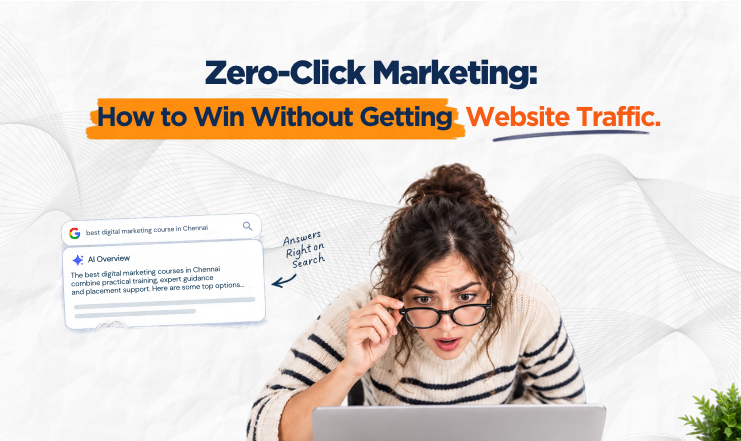
Zero-Click Marketing: How to Win Without Getting Website Traffic
Web D School | Expert Economy
For years, digital marketing followed a simple path:
Search or ad → website click → conversion
That journey is changing.
Customers no longer need to visit a website before they discover, evaluate, trust, remember, or even choose a brand. They may find a business through Google Maps, an AI-generated answer, a featured search result, a YouTube video, an Instagram Reel, customer reviews, a marketplace listing, or a WhatsApp button.
They may then call, message, request directions, visit a store, or search for the brand later.
This is zero-click marketing.
Zero-click marketing means creating visibility, trust, and opportunities for action directly where customers search and make decisions, even when they do not visit your website. Learning these strategies through a Full Stack Digital Marketing Course can help marketers understand how to build brand visibility across search engines, social media, and other digital channels.
Zero-click does not mean zero value.
It means the value may appear as brand recognition, trust, enquiries, store visits, branded searches, bookings, or purchases rather than website traffic.
What Is Zero-Click Marketing?
Zero-click marketing is a digital marketing approach where customers can discover, understand, trust, and act on a brand without necessarily visiting its website.
For example:
Google Maps → Reviews → Directions → Store visit
is a successful customer journey even though the website was never visited.
Other examples include:
- Calling directly from Google Search
- Sending a WhatsApp message from a business profile
- Watching a YouTube video and later purchasing
- Reading an AI-generated answer that mentions a brand
- Finding a product through a marketplace
- Discovering a business through Instagram
- Reading reviews before making an offline purchase
The key change is that the website is no longer automatically the centre of every customer journey.
1. Understand Why Zero-Click Marketing Matters in 2026
Search is increasingly becoming an environment where users can get answers, compare options, and make decisions without opening multiple websites.
Google’s AI-powered search experiences can provide summaries and support conversational exploration. AI systems can also combine information from multiple searches and sources before presenting an answer.
Research has already indicated that AI-generated search summaries can influence traditional click behaviour.
That does not mean website traffic is becoming irrelevant.
It means marketers need to recognise a bigger reality:
Customers can receive significant value from a brand before visiting its website—or without visiting it at all.
This makes visibility outside the website increasingly important.
A modern marketing strategy therefore needs to answer two questions:
- Can customers find us?
- What happens when they find us?
2. Stop Treating Website Traffic as the Only Sign of Success
Website traffic is useful, but it is only one part of the customer journey.
Consider two businesses.
Business A
- 10,000 website visits
- Low purchase intent
- Many visitors outside the service area
- High bounce rate
- Few enquiries
Business B
- 3,000 website visits
- 300 Google Maps calls
- 180 WhatsApp enquiries
- 120 direction requests
- Strong review activity
- Increasing branded searches
Which business has stronger marketing?
You cannot answer that from website traffic alone.
The better question is:
Did the marketing interaction move the customer closer to choosing the business?
A useful zero-click measurement model is:
Visibility → Understanding → Trust → Action
Website traffic may contribute to that journey, but it is not the only path.
3. Recognise the Four Types of Zero-Click Value
Not every zero-click interaction has the same purpose.
A useful way to understand zero-click marketing is to divide its value into four categories.
1. Immediate Action
The customer takes action directly from the platform.
Examples include:
- Calling a business
- Requesting directions
- Booking an appointment
- Sending a WhatsApp message
- Ordering from a marketplace
- Making a reservation
The customer does not need to visit the website.
2. Trust Creation
The customer does not act immediately but becomes more confident about the brand.
Examples include:
- Reading reviews
- Watching testimonials
- Seeing customer photographs
- Watching product demonstrations
- Reading educational content
- Seeing a brand referenced in an AI answer
- Finding credible third-party recommendations
The interaction may not produce an immediate conversion, but it can reduce uncertainty.
3. Brand Memory
Sometimes the customer simply remembers the brand.
Imagine someone repeatedly encounters the same company through:
- Google Search
- Google Maps
- YouTube
- Reviews
- AI answers
- Educational content
Eventually, they may stop searching for the category and search directly for the brand.
That is an important marketing outcome.
The business has moved from being one possible option to becoming a remembered option.
4. Assisted Conversion
Discovery may happen on one platform while the final conversion occurs somewhere else.
For example:
Google Maps → Instagram → WhatsApp → Offline purchase
or:
YouTube → Brand Search → Website → Enquiry
or:
AI Answer → Brand Memory → Google Maps → Store Visit
The final conversion platform does not necessarily deserve all the credit.
Earlier interactions may have helped create the confidence required for the customer to act.
4. Understand That Zero-Click Does Not Mean Zero Action
A customer may never visit your website and still:
- Call your business
- Send a WhatsApp message
- Request directions
- Visit your store
- Book an appointment
- Save your content
- Follow your account
- Subscribe to your channel
- Search your brand later
- Recommend your business
- Purchase through another platform
Therefore:
No website click does not automatically mean no marketing result.
The better question is:
Did the interaction help the customer move closer to choosing us?
This is one of the most important mindset changes in modern digital marketing.
5. See Why the Website Is No Longer Always the Destination
Imagine a student researching a digital marketing course.
Day 1
The student asks an AI assistant:
“Is digital marketing still a good career in the AI era?”
They discover an institute or educational resource.
No website visit.
Day 2
They search:
“Digital Marketing Course in Chennai“
They find a business profile and read reviews.
No website visit.
Day 3
Instagram recommends a Reel showing a student project.
No website visit.
Day 5
They search YouTube and watch a student testimonial.
Still no website visit.
Day 7
They search the institute’s brand name, find the phone number, and call.
The website may have received no visit from that customer.
Yet multiple digital touchpoints contributed to the enquiry.
The journey was:
Discovery → Understanding → Trust → Action
not necessarily:
Search → Website → Conversion
The website can appear anywhere in the journey.
It does not have to be the first destination.
6. Optimise for Discoverability Across More Than Search Engines
Customers can discover businesses in many places.
A modern visibility strategy should consider:
- Google Search
- Google Maps
- Business Profiles
- YouTube
- Reviews
- Marketplaces
- AI search
- Comparison websites
- Community platforms
- Messaging platforms
The important question is:
Where does my customer look before making this decision?
For a restaurant, it may be Google Maps.
For a course provider, it may be Google Search, YouTube, Instagram, and AI search.
For an ecommerce brand, it may be Google, marketplaces, social media, reviews, and comparison content.
The platform changes.
The principle remains the same:
Be present where the decision begins.
7. Make Your Google Business Profile a Zero-Click Conversion Asset
For local businesses, Google Maps and Business Profiles can function almost like mini landing pages.
A customer may see:
- Business name
- Category
- Rating
- Reviews
- Photographs
- Opening hours
- Address
- Phone number
- Services
- Menu information
- Directions
- Booking or ordering options
They may make a decision immediately.
For example:
Search → Maps → Reviews → Call
can generate a customer without a website visit.
This means local businesses should treat their Business Profile as an important marketing asset rather than simply an online directory listing.
8. Build Trust Before Asking for the Click
Traditional content marketing can sometimes follow this pattern:
Interesting headline → hide the useful information → ask for the click
Zero-click marketing encourages a different approach:
Useful answer → trust → optional deeper action
Suppose a digital marketing institute publishes:
“5 skills employers expect from a performance marketing fresher.”
A weak post might say:
“Want to know the five skills? Click the link in bio.”
A stronger post actually explains the five skills.
Then it can offer:
Download the complete fresher portfolio checklist to practise them.
The audience receives value immediately.
The website provides the next level of value.
That creates a healthier relationship between content and conversion.
9. Give the Answer First, Then Offer Deeper Value
A common concern is:
“If we give people the answer on social media or search, why would they visit our website?”
The answer is simple:
The website should provide depth, not simply hide basic information.
For example:
Social Media
5 mistakes students make in their first Google Ads campaign
The post explains the five mistakes.
Website
The website offers:
- A complete Google Ads practice project
- Campaign brief
- Sample campaign structure
- Downloadable worksheet
- Evaluation checklist
The social post provides the answer.
The website provides the experience.
Another example:
Google Maps
Provides:
- Location
- Opening hours
- Reviews
- Photos
Website
Provides:
- Detailed service comparison
- Portfolio
- Case studies
- Pricing information
- Application form
The website still matters.It simply has a stronger reason to exist.
10. Use the Discoverable–Understandable–Trustworthy–Actionable Framework
A simple framework can help businesses audit their zero-click presence.
1. Discoverable
Can the right customer find us?
Check:
- Search visibility
- Maps visibility
- Social search
- YouTube
- Reviews
- Marketplaces
- AI answers
2. Understandable
Can customers quickly understand what we offer, where we operate, and who we serve?
Customers should not need to investigate several platforms just to understand the basics.
Your information should be:
- Clear
- Consistent
- Specific
- Easy to scan
3. Trustworthy
Is there enough evidence for the customer to believe us?
Useful trust signals include:
- Reviews
- Testimonials
- Case studies
- Customer photographs
- Demonstrations
- Expertise
- Third-party mentions
- Useful educational content
4. Actionable
Can the customer easily take the next useful step?
Depending on the business, that action could be:
- Call
- Book
- Visit
- Request directions
- Download
- Enquire
- Purchase
The complete model becomes:
Discoverable → Understandable → Trustworthy → Actionable
11. Optimise for Zero-Click Search Visibility
Google Search can provide information through multiple formats before a user reaches a website.
Customers may encounter:
- AI-generated summaries
- Featured results
- Videos
- Local results
- Product information
- Business information
- Rich search features
This changes the content objective.
Instead of asking only:
“How can I get the click?”
also ask:
“How can my content become useful enough to be selected, displayed, understood, or referenced?”
That requires clear, accurate, useful information.
12. Build Visibility for AI-Generated Answers
AI search introduces another layer of discovery.
A customer may ask:
“Which accounting software is suitable for a small Indian business?”
Or:
“How do I choose a good UI/UX course?”
Or:
“What should I check before choosing a digital marketing institute in Chennai?”
An AI system may use information from multiple sources to construct its response.
This creates a new visibility opportunity.
But there is an important distinction:
AI citation is a visibility signal, not proof of business success.
A brand may be mentioned in an AI answer and still generate no enquiry.
Therefore, AI visibility should ultimately be connected to:
Visibility → Trust → Action → Business outcome
13. Make Social Media a Complete Discovery Environment
Social media is no longer only about follower growth.
Platforms such as Instagram, YouTube, and LinkedIn can help customers discover, understand, and evaluate a business without leaving the platform.
Imagine a bakery’s Instagram profile.
A potential customer can see:
- Cake designs
- Customer reactions
- Pricing information
- Product demonstrations
- Behind-the-scenes videos
- Location
- Reviews
- Comments
- Contact options
The customer may already understand enough to make a decision.
This means social content should answer customer questions instead of simply promoting the brand.
14. Use Reviews as Marketing Content, Not Just Reputation Signals
Reviews can influence zero-click decisions because they provide evidence without requiring a website visit.
A customer comparing two restaurants may look at:
- Star rating
- Number of reviews
- Review recency
- Customer comments
- Business responses
- Customer photographs
The business may win the decision before the customer ever visits its website.
Therefore, review strategy should focus on:
- Generating genuine reviews
- Keeping information accurate
- Responding professionally
- Encouraging detailed customer feedback
- Monitoring recurring complaints
- Learning from customer questions
A five-star rating is useful.
But specific evidence is often more persuasive than a number alone.
15. Measure Zero-Click Marketing With Three Groups of Metrics
A useful dashboard can divide zero-click performance into three groups.
Visibility Metrics
Measure whether people are encountering the brand.
Examples:
- Search impressions
- Maps visibility
- Profile views
- Social reach
- Video reach
- AI citations
- Brand mentions
- Search visibility
Trust Metrics
Measure whether customers are becoming more confident.
Examples:
- Review volume
- Review recency
- Saves
- Shares
- Branded searches
- Repeat profile visits
- Positive comments
- Customer questions
- Testimonial engagement
Action Metrics
Measure whether visibility produces meaningful behaviour.
Examples:
- Phone calls
- WhatsApp conversations
- Direction requests
- Bookings
- Qualified enquiries
- Store visits
- Purchases
- Repeat purchases
The important point is to connect these metrics.
A million impressions with no trust or action may have little business value.
A smaller audience that produces hundreds of qualified enquiries may be significantly more valuable.
16. Do Not Replace Click Vanity With Citation Vanity
There is another trap marketers need to avoid.
If marketers stop obsessing over website clicks and start obsessing over AI citations, they may simply replace one incomplete metric with another.
For example:
- 20 AI citations do not automatically mean revenue increased.
- 100,000 impressions do not automatically mean customers trust the brand.
- 50,000 video views do not automatically mean sales.
- A high ranking does not automatically mean profitable traffic.
These are signals.
They need to be connected to outcomes.
The better principle is:
Visibility is not the same as value.
A more useful definition is:
Value is visibility that helps create understanding, trust, and action.
17. Apply the SPARK Lens: Spot the Unseen
Suppose a local business says:
“Our website traffic is low. We need to publish more articles.”
That may be the right solution.
But it may also be the wrong diagnosis.
Before producing more content, ask:
Is website traffic actually the problem?
The deeper issue could be:
- An incomplete Google Business Profile
- Old reviews
- Poor local search visibility
- Weak photographs
- Difficult contact options
- Unclear social profiles
- Inconsistent information across platforms
- Weak trust signals
- Poor conversion paths
- No obvious next action
This is where the SPARK Lens — Spot the Unseen becomes useful.
Do not immediately solve the visible symptom.
First understand the system underneath it.
18. Audit Every Customer Touchpoint for Four Questions
The four zero-click questions can be applied across different platforms.
Google Search
Ask:
- Can customers find us?
- Is our message clear?
- Does the result communicate relevance?
- Is there enough information to create confidence?
Google Maps
Ask:
- Is the business information accurate?
- Are the photographs current?
- Are reviews recent?
- Can customers call or get directions easily?
Social Media
Ask:
- Is it immediately obvious what we offer?
- Is the location clear?
- Is the target audience clear?
- Can customers easily message or take action?
Video
Ask:
- Does the video answer a real customer question?
- Does it demonstrate expertise?
- Does it create trust?
- Is the next action obvious?
Reviews
Ask:
- Are reviews recent?
- Do they describe actual experiences?
- Does the business respond professionally?
- Do customers mention the qualities future buyers care about?
AI Search
Ask an AI system natural questions that a real customer might ask.
For example:
“How do I choose a good digital marketing institute in Chennai?”
Then observe:
- Which businesses appear?
- Which sources are mentioned?
- What information is being used?
- What questions does the AI still seem unable to answer?
Do not treat a single AI response as a permanent ranking.
AI answers can change based on the system, query, context, sources, and time.
19. Keep the Website—But Give It a Better Job
Zero-click marketing is not anti-website.
A strong website remains valuable because the business can use it for:
- Detailed information
- Brand presentation
- Lead generation
- Sales
- Applications
- Case studies
- Portfolio content
- Downloads
- Email collection
- Customer education
- Conversion journeys
A website also gives the business more control than many third-party platforms.
The lesson is not:
“Websites are becoming useless.”
The better lesson is:
“The website is one part of a larger customer journey.”
If Google Maps already provides the address, forcing someone to visit a website just to find the address creates unnecessary friction.
But if the customer needs:
- Detailed comparisons
- Case studies
- Pricing
- Product specifications
- Applications
- Downloads
the website becomes extremely valuable.
20. Balance Zero-Click Marketing With Owned Assets
Zero-click visibility can create another risk: platform dependence.
A business may build most of its visibility on platforms it does not control.
For example, social platforms control:
- Distribution
- Algorithms
- Features
- Reach
- Account policies
Search engines control their interfaces.
Marketplaces control their listings.
AI platforms control how answers are generated.
Therefore, businesses should use external platforms for discovery while gradually building assets they control.
These can include:
- Website
- CRM
- Customer database
- Email list
- Permission-based messaging
- First-party customer information
- Customer community
A useful principle is:
Use platforms for discovery. Build owned assets for relationships.
21. Understand How AI Visibility Is Changing Measurement
Search measurement is expanding beyond traditional clicks.
Modern search platforms are increasingly providing ways to understand how content appears within generative search experiences.
This creates a new question for marketers:
Instead of asking only:
“How many people clicked our website?”
marketers also need to ask:
“Where and how did our content participate in AI-driven discovery?”
But AI visibility should not become another vanity metric.
The ultimate goal remains:
Visibility → Understanding → Trust → Action → Business outcome
22. Follow Google’s Fundamental SEO Principles
The growth of AI search does not mean businesses need mysterious “AI SEO hacks.”
The fundamental principles remain important:
- Clear information
- Accurate business details
- Helpful content
- Relevant internal links
- Good page experience
- Useful text
- Relevant images and videos
- Appropriate structured data
- Accurate and updated information
The goal should not be to create content exclusively “for AI.”
The better objective is:
Create information that people can understand and systems can accurately interpret.
That makes content useful across traditional search, AI search, social platforms, and other discovery environments.
23. Build a Zero-Click Content Strategy
A strong zero-click strategy should change how content is created.
Instead of:
Headline → teaser → click
consider:
Question → useful answer → evidence → optional deeper action
For example:
Weak Approach
“Want to know the 7 best SEO strategies? Click here.”
Stronger Approach
“Here are 7 SEO strategies businesses can use in 2026:
- Build topic depth.
- Improve search intent alignment.
- Create useful original content.
- Strengthen internal linking.
- Improve local visibility.
- Build credible mentions.
- Make important information easy for users and systems to understand.
Want the complete implementation checklist? Download it here.”
The second approach creates value before the click.
24. Measure the Entire Customer Journey, Not Just the Final Click
A modern customer journey might look like:
AI Answer → Instagram → Google Search → Reviews → Maps → WhatsApp → Purchase
Which platform caused the sale?
There may not be one simple answer.
Several touchpoints may have contributed.
This is why marketers should combine:
- Platform analytics
- Website analytics
- CRM data
- Call tracking
- WhatsApp enquiries
- Booking data
- Store visits
- Branded search trends
- Customer feedback
The objective is to understand the system, not reward whichever platform happened to receive the final interaction.
25. Build a Zero-Click Marketing Checklist
Before publishing or optimising a channel, ask these questions.
Discoverability
- Can customers find us?
- Are we visible where they search?
- Are our profiles complete?
- Are our important topics covered?
Understanding
- Can someone understand our offer quickly?
- Is our location clear?
- Is our target audience clear?
- Is our information consistent?
Trust
- Are reviews visible?
- Do we have testimonials?
- Do we show real customer experiences?
- Do we demonstrate expertise?
- Are third-party mentions available?
Action
- Can people call us?
- Can they message us?
- Can they get directions?
- Can they book?
- Can they buy?
- Can they enquire?
Measurement
- Are we measuring visibility?
- Are we measuring trust?
- Are we measuring actions?
- Can we connect those actions to business outcomes?
If the answer is yes across these areas, the business is better positioned for zero-click discovery.
The Future of Digital Marketing Is Bigger Than Website Traffic
Zero-click marketing does not mean website traffic no longer matters.
It means website traffic is no longer enough to explain the entire customer journey.
A customer may discover your business on Google Maps, understand your offer through Instagram, trust you because of reviews, encounter your brand again through an AI answer, and finally contact you through WhatsApp.
The website may never appear.
The marketing can still succeed.
This changes the central question from:
“How much traffic did we generate?”
to:
“How easily can customers discover, understand, trust, and act on our brand?”
That is the bigger opportunity behind zero-click marketing.
The businesses that win in 2026 may not necessarily be those generating the most website visits.
They may be the businesses that are easiest to:
Discover.
Understand.
Trust.
Act on.
Wherever the customer happens to search.
Frequently Asked Questions About Zero-Click Marketing
1. What is zero-click marketing?
Zero-click marketing is a strategy that helps customers discover, understand, trust, and act on a brand without requiring them to visit its website. Examples include Google Maps calls, social media interactions, AI-generated answers, reviews, marketplace purchases, and direct messaging.
2. Does zero-click marketing mean websites are becoming useless?
No. Websites remain important for detailed information, lead generation, ecommerce, applications, case studies, downloads, and conversion journeys. Zero-click marketing simply recognises that customers can complete some parts of their journey without visiting a website.
3. Why is zero-click marketing important in 2026?
Zero-click marketing matters because search, social media, maps, AI platforms, reviews, and marketplaces increasingly allow customers to discover information and take action without opening a website. This makes visibility and conversion outside the website increasingly important.
4. How does Google Maps support zero-click marketing?
Google Maps can provide business information such as location, opening hours, reviews, photographs, phone numbers, services, directions, and booking or ordering options. A customer can use this information to choose a business without visiting its website.
5. How does AI search affect zero-click marketing?
AI search can answer questions, summarise information, compare options, and reference sources before a user visits a website. This means businesses increasingly need content that is clear, useful, trustworthy, and easy for both people and AI systems to understand.
6. What are examples of zero-click conversions?
Examples include:
- Phone calls
- WhatsApp messages
- Direction requests
- Bookings
- Store visits
- Marketplace purchases
- Social media enquiries
- Appointment requests
- Brand searches
- Offline purchases
Is website traffic still important?
Yes. Website traffic remains useful for businesses that need detailed information, lead capture, ecommerce, applications, case studies, or other website-based conversions. However, it should be measured alongside other customer actions.
7. What should businesses measure instead of website traffic?
Businesses should measure three categories:
Visibility: impressions, reach, Maps visibility, AI citations, mentions.
Trust: reviews, saves, shares, branded searches, repeat profile visits.
Action: calls, messages, bookings, enquiries, store visits, purchases, and repeat purchases.
8. How can a business improve zero-click visibility?
A business can improve zero-click visibility by:
- Optimising its Google Business Profile.
- Creating useful search-focused content.
- Building strong reviews and testimonials.
- Publishing useful social content.
- Creating informative videos.
- Maintaining consistent business information.
- Building credible third-party mentions.
- Creating content that answers real customer questions.
- Making contact and purchase actions easy.
- Measuring visibility together with business outcomes.
9. What is the difference between zero-click marketing and traditional SEO?
Traditional SEO has historically focused heavily on earning search visibility and website clicks. Zero-click marketing takes a broader approach by also considering what happens directly within search, Maps, AI answers, social platforms, reviews, videos, and other discovery environments.
10. Can zero-click marketing help local businesses?
Yes. Local businesses can benefit significantly because customers often make decisions directly from Maps, reviews, local search results, social media, and messaging platforms. Restaurants, clinics, salons, retailers, educational institutes, and service businesses can all use zero-click strategies.
11. Should businesses give away information for free?
Yes, when the information helps build trust and demonstrates expertise. The goal is not to hide useful information behind a click. Instead, give customers a useful answer first and offer deeper value through detailed guides, tools, case studies, downloads, services, or other resources.
12. What is the biggest mistake in zero-click marketing?
The biggest mistake is replacing one vanity metric with another. Moving from obsessing over website clicks to obsessing over AI citations, impressions, views, or rankings does not solve the underlying problem. Visibility only becomes valuable when it contributes to understanding, trust, action, and business outcomes.
13. What is the simplest framework for zero-click marketing?
A simple framework is:
Discoverable → Understandable → Trustworthy → Actionable
First, customers need to find the business. Then they need to understand it, trust it, and have an easy way to take the next step.
Final Takeaway
The future of digital marketing is not simply about getting people to click.
It is about being present, useful, credible, and actionable wherever customers make decisions.
The winning question is no longer:
“How do we get more website traffic?”
It is:
“How do we become the easiest brand to discover, understand, trust, and choose?”
That is the real opportunity behind zero-click marketing.
Zero clicks can still create real customers.