
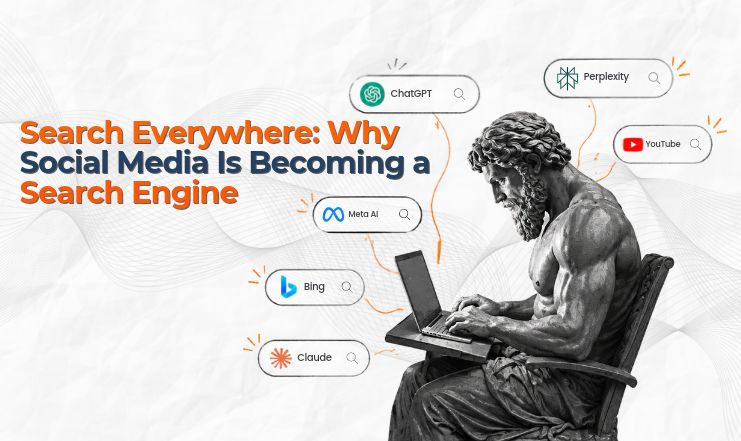
Search Everywhere: Why Social Media Is Becoming a Search Engine
Web D School | Expert Economy
For years, digital discovery followed a simple path:
Search on Google → Click a website → Learn → Convert
That journey is changing.
Today, people discover businesses, products, courses, restaurants, services, and ideas across Google, YouTube, Instagram, TikTok, Reddit, Google Maps, marketplaces, and AI assistants.
Google is still important. But it is no longer the only place where discovery happens.
The bigger shift is this:
Search is becoming a journey across platforms rather than a single destination.
A customer might discover a brand on Instagram, watch a YouTube video to understand it, check Reddit for opinions, compare options on Google, read Maps reviews, and finally enquire through WhatsApp.
This shift also highlights why a Full Stack Digital Marketer needs to understand how SEO, social media, content marketing, and other digital channels work together to create a seamless customer journey.
This changes how businesses need to think about SEO, content, and digital marketing.
1. Search Is Moving Beyond Google
People use different platforms for different types of questions.
For example, someone considering a digital marketing course might:
- Search Google for “digital marketing course in Chennai”
- Watch YouTube videos about digital marketing careers
- Browse Instagram for student projects and course content
- Ask Reddit users whether learning digital marketing is worthwhile
- Check Google Maps for nearby institutes and reviews
- Ask an AI assistant to compare different career options
These are all forms of search behaviour.
The important question is no longer:
It is:
“Where does my audience go when they need this type of answer?”
2. Discovery Now Happens Across Multiple Platforms
Modern customer journeys can look very different.
Example 1: Education
Instagram → YouTube → Google → Reddit → WhatsApp A student discovers a course through a Reel, watches an explanation, searches for alternatives, validates opinions, and finally sends an enquiry.
Example 2: Local Business
Instagram → Google Maps → Reviews → Phone Call
Someone sees a restaurant video, checks its location and reviews, and calls to make a reservation.
Example 3: Software
Google → YouTube → Reddit → AI → Website
A potential customer researches a software solution, watches a demonstration, checks user experiences, asks AI to compare options, and then visits the website.
The website still matters—but it may no longer be the first or only destination.
3. Each Platform Answers a Different Customer Question
The same topic behaves differently depending on where the customer searches.
| Platform | Typical Customer Need |
| Research and comparison | |
| YouTube | Demonstration and explanation |
| Discovery and visual proof | |
| TikTok | Quick discovery and trends |
| Honest experiences and opinions | |
| Google Maps | Local trust and action |
| Marketplaces | Product comparison and purchase |
| AI assistants | Synthesis and decision support |
This creates a useful five-stage model:
Discovery → Understanding → Validation → Comparison → Action
The mistake is expecting one platform to handle every stage.
4. Search Everywhere Does Not Mean Posting Everywhere
“Be everywhere” sounds like a good marketing strategy—but it can quickly become a content-production problem.
Publishing the same blog paragraph on your website, Instagram, YouTube, Reddit, and LinkedIn isn’t a Search Everywhere strategy.
It is simply copy-paste distribution.
Instead, take one useful idea and adapt it.
For example, the topic:
“How to choose a Full stack digital marketing course”
could become:
- Google: Detailed comparison guide
- YouTube: “5 Things to Check Before Joining a Full stack digital marketing course”
- Instagram: Saveable carousel
- Reel: Three warning signs to watch for
- Reddit: Genuine discussion about choosing a course
- WhatsApp: Simple comparison checklist
The core information remains consistent, but the format changes according to the platform.
5. The Customer Doesn’t Think in Marketing Channels
Businesses often separate marketing into:
SEO + Social Media + Video + Paid Ads + CRM
Customers don’t.
They simply think:
“I’m trying to decide whether this is right for me.”
One interaction can lead to another:
Instagram → Google Search → YouTube → Reddit → Maps → WhatsApp This means businesses should design content around the customer’s decision journey, rather than treating every channel as an isolated department.
SPARK Lens: Spot the Unseen
Instead of asking:
“Which social media platform should we use?”
Ask:
- Where does the customer begin researching?
- Where do they look for proof?
- Where do they compare options?
- Where do they seek honest opinions?
- Where do they finally take action?
The right platform depends on the customer’s decision, not simply on which platform is popular.
6. Social Search Requires Different Content
Search behaviour is not identical across platforms.
Someone might search Google for:
“ Best digital marketing course in chennai ”
On Instagram, they might search:
“Anna Nagar veg food”
On Reddit, the question could become:
“Where do locals actually eat vegetarian food around Anna Nagar?”
The underlying intent is similar, but the language changes.
That’s why social search optimisation isn’t about copying Google keywords into captions.
It means understanding how people naturally search on each platform.
7. Make Your Content Easy to Discover
A few simple practices can improve discoverability across platforms:
Make the topic obvious
Don’t hide the subject behind a clever headline.
Instead of:
“My Thoughts on Career Growth”
use:
“Can You Build a Digital Marketing Career Without Coding?”
Use natural language
Write the way your audience actually speaks and searches.
Make video topics explicit
Clearly mention the subject in the title and spoken content.
Answer real questions
Comments can reveal what people want to know next.
Create searchable evergreen content
A Reel may generate attention today, while a useful guide can continue generating discovery months later.
8. Keep the Facts Consistent Everywhere
Adaptation does not mean changing the truth.
Your:
- Business name
- Location
- Pricing
- Opening hours
- Services
- Course details
- Product information
- Claims
should remain consistent across platforms.
For example, if your website says Saturday classes available, but Google Maps says closed on Saturdays, customers don’t see two marketing messages.
They see confusion.
The presentation can change.
The facts shouldn’t.
9. Search Everywhere Connects With Zero-Click Marketing
Search Everywhere and zero-click marketing are closely connected.
A customer may:
- Discover a business on Instagram and send a DM
- Watch a YouTube video and call directly
- Find a restaurant through Maps and visit it
- Read a Reddit recommendation and purchase elsewhere
- Ask AI for a recommendation and search the brand afterward
The customer doesn’t always need to visit a website.
Therefore, the goal shouldn’t always be:
“How do we get website traffic?”
It should be:
“How do we help customers discover, understand, trust, and act?”
That is a much broader definition of digital visibility.
10. Build a Search Everywhere Strategy Around Decisions
Don’t begin with a platform list.
Begin with the customer’s decision.
Ask:
What are they trying to discover?
“What options are available?”
What are they trying to understand?
“How does this work?”
What are they trying to validate?
“Can I trust this?”
What are they comparing?
“Which option is better for me?”
What action are they ready to take?
“How do I contact, visit, or buy?”
Then match each question with the platform where your audience naturally looks for that answer.
This creates a connected strategy instead of disconnected content.
11. Measure Platforms According to Their Role
Not every platform should be judged by the same metric.
For example:
- Google: Impressions, clicks, qualified traffic, conversions
- YouTube: Search impressions, watch time, retention, assisted conversions
- Instagram/TikTok: Search discovery, saves, shares, DMs
- Reddit: Relevant visibility, comment quality, referral activity
- Maps: Calls, direction requests, reviews
- Website: Enquiries, leads, purchases, conversions
The important question is:
Did this discovery contribute to a meaningful customer action?
A platform with fewer clicks may still influence a valuable purchase decision.
12. Avoid These Common Search Everywhere Mistakes
1. Posting everywhere without a purpose
More platforms don’t automatically create more customers.
2. Copying the same content everywhere
One idea can travel across platforms, but the execution should change.
3. Optimising only for views
High reach doesn’t necessarily mean high business value.
4. Ignoring comments
Comments often reveal the next question customers want answered.
5. Keyword stuffing
Natural, useful language is more valuable than forcing keywords into every caption.
6. Treating communities like advertising space
Platforms such as Reddit depend heavily on trust and genuine participation.
The Future of Discovery Is Connected
Google isn’t disappearing.
Instead, Google is becoming one part of a much larger discovery ecosystem.
A customer might:
Discover on Instagram → Learn on YouTube → Validate on Reddit → Compare on Google or AI → Check Maps → Contact through WhatsApp
The modern marketer therefore needs to think beyond:
The better question is:
“Where is my customer searching at each stage of their decision—and is my brand useful there?”
That is the idea behind Search Everywhere.
It’s not about publishing everywhere.
It’s about being discoverable wherever the customer’s decision develops.
Frequently Asked Questions
1. What is Search Everywhere in digital marketing?
Search Everywhere is the approach of making a brand discoverable across the platforms where customers search for information, including Google, YouTube, Instagram, TikTok, Reddit, Maps, marketplaces, and AI assistants.
2. Is Google still important for search?
Yes. Google remains a major search platform, but customers increasingly use multiple platforms for discovery, research, validation, comparison, and action.
3. Why is social media becoming a search engine?
Users increasingly search social platforms for products, reviews, recommendations, tutorials, creators, restaurants, courses, and experiences. Social platforms can therefore influence discovery well before a customer visits a website.
4. Should businesses post the same content on every platform?
No. The core idea can remain consistent, but the format, depth, language, opening, and call to action should be adapted to each platform.
5. How can businesses optimise content for social search?
Use clear topics, natural language, descriptive titles, relevant keywords, useful video descriptions, searchable captions, and content that directly answers questions customers are asking.
6. What is the difference between SEO and Search Everywhere?
Traditional SEO often focuses heavily on visibility in search engines such as Google. Search Everywhere expands the idea of discovery across search engines, social platforms, video platforms, communities, maps, marketplaces, and AI assistants.
7. Does Search Everywhere mean a business needs to be on every platform?
No. The goal isn’t maximum platform coverage. The goal is to be present on the right platforms for the customer’s decision journey.
8. How does AI change search discovery?
AI assistants can synthesise information from multiple sources and help users compare or evaluate options without requiring them to visit every source directly. This makes brand visibility, trustworthy information, and consistent digital presence increasingly important.
9. What is the main benefit of a Search Everywhere strategy?
It helps businesses reach customers at multiple stages of the decision journey—from initial discovery to understanding, validation, comparison, and action.
10. What is the key idea behind Search Everywhere?
Search is no longer one destination. It is a connected discovery journey across platforms. Businesses should focus on being useful and discoverable wherever their customers are making decisions.