
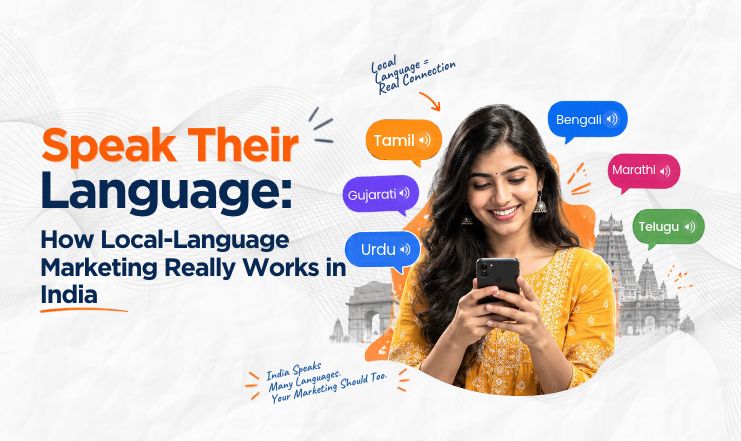
Speak Their Language: How Local-Language Marketing Really Works in India
Web D School | Expert Economy
Local-Language Marketing in India: A Practical Guide to Learn how local-language marketing works in India, from Tamil and Tanglish to voice search, video, WhatsApp, localisation, and AI-friendly content strategies.
For many Indian businesses, English-first marketing is no longer enough. Customers may search in English, watch a Tamil video, type questions in Tanglish on WhatsApp, and read detailed information in English before making a purchase.
A Chennai student, for example, might search “digital marketing course in Chennai,” watch a Tamil Reel, ask “Weekend batch இருக்கா?” on WhatsApp, and then read an English course syllabus.
This reveals an important marketing principle:
Local-language marketing is not simply translating English content. It is adapting the message to the way customers naturally search, speak, understand, and make decisions.
Here are 7 practical ways to understand and implement local-language marketing in India.
1. Understand That Localisation Is More Than Translation
Translation changes words from one language to another. Localisation changes the way an idea is communicated so it feels natural to the audience.
For example:
English:
“Build a future-ready digital marketing career.”
A localised campaign could use:
- Formal Tamil for an educational article
- Tamil-English for an urban student audience
- Tanglish for a casual Reel
- Conversational language for WhatsApp
The core message should remain unchanged, while the tone, rhythm, examples, and call-to-action can change.
This is particularly important for brands promoting education, such as a Full Stack Digital Marketing Course, where technical terms like SEO, AI, portfolio, analytics, and internship may be clearer when retained in English.
Simple rule:
Translation transfers words. Localisation transfers meaning and relevance.
2. Stop Treating the Tamil Audience as One Audience
There is no single “Tamil-speaking audience.”
Language preferences can vary according to:
- Age
- Location
- Education
- Profession
- Platform
- Buying situation
- Familiarity with English
A college student in Chennai may naturally use words such as SEO, portfolio, internship, leads, and performance marketing.
A Tamil-first audience may prefer more Tamil explanations.
The goal is therefore not to create “pure Tamil” content at all costs. The goal is to use the language combination the audience actually understands and trusts.
For example:
Natural:
“Weekend batch இருக்கா?”
Forced:
A highly formal Tamil sentence that nobody would normally use in conversation.
The best question for marketers is not:
“Is this grammatically perfect?”
It is:
“Would my target customer actually say this?”
3. Choose Between Tamil Script, Tamil-English and Tanglish
Different formats work for different situations.
Tamil Script
Useful for:
- Tamil-first audiences
- Educational explanations
- Emotional storytelling
- Longer-form content
- Conversational promotions
- Regional audiences
Tamil-English Mix
Useful for:
- Urban audiences
- College students
- Professional audiences
- Technical subjects
For example:
“AI வந்தாலும் Digital Marketing career முடிஞ்சிடாது. Skills மட்டும் change ஆகுது.”
Tanglish
Useful for:
- Reels
- Informal social content
Example:
“Tools mattum kathukkaama real campaigns panni portfolio build pannunga.”
However, Tanglish can become difficult to read when used for long educational content because spelling is not standardised.
The objective isn’t language purity.
The objective is clarity.
4. Use the Three-Layer Localisation Framework
A simple framework for local-language marketing is:
Meaning → Voice → Culture
Meaning:
Keep the original promise accurate.
Voice:
Express it in the way the specific audience naturally speaks.
Culture:
Use locally relevant examples, situations, concerns, and references.
For example, instead of simply translating:
“Build your side hustle.”
A locally relevant version might communicate:
“வேலை செய்து கொண்டே freelance income உருவாக்கணுமா?”
The benefit remains similar, but the context becomes easier to understand.
You can also use this model:
Brand Truth → Audience Language → Local Context
Your brand promise should never change just because the language changes.
For example:
Original:
“Build a portfolio through practical projects.”
Incorrect localisation:
“Course முடிச்ச உடனே job guaranteed.”
That isn’t localisation. It is an entirely different claim.
The key principle:
Preserve the promise. Adapt the expression.
5. Build Content Around How People Actually Search and Speak
Local-language search behaviour is changing because people don’t always type the way they speak.
A typed query might be:
“Best digital marketing course in Chennai”
A spoken query could be:
“Chennai-la beginner-ku suitable-aana digital marketing course edhu?”
Voice searches are often:
- Longer
- More conversational
- Question-based
- Contextual
- More specific
This means marketers should research real customer language, not simply translate English keywords.
Look at:
- Search queries
- WhatsApp questions
- Sales calls
- Customer reviews
- Instagram comments
- Frequently asked questions
For example, if customers repeatedly ask “Weekend batch இருக்கா?”, that question itself can become:
- A website FAQ
- A Reel topic
- A Google Business Profile post
- A YouTube video
- A WhatsApp conversation starter
This creates content that matches real customer intent.
6. Use Video and WhatsApp as Local-Language Conversion Channels
Video is one of the strongest formats for local-language marketing because it allows brands to combine:
Spoken Tamil + English technical terms + Tamil subtitles + Visual demonstrations
A Tamil educational video can explain a complicated topic more naturally than a long translated article.
But localisation shouldn’t stop at dubbing.
A genuinely localised video may also change:
- The opening hook
- Presenter style
- Examples
- Pacing
- Visual references
- Subtitles
- Background elements
- Call-to-action
The same principle applies to WhatsApp.
If a customer asks:
“Fees எவ்வளவு?”
A robotic response such as:
“Dear Sir/Madam, kindly furnish your qualification details.”
can immediately break the connection.
A conversational response could be:
“Course option-ஐ பொறுத்து fee மாறும். Online பார்க்கிறீங்களா, classroom பார்க்கிறீங்களா?”
The important point is that language consistency becomes part of customer service.
If a Tamil Reel brings the customer in, but the landing page, form, and WhatsApp conversation suddenly become overly formal English, the journey can feel disconnected.
7. Measure Local-Language Marketing by Business Outcomes
Don’t decide that a language “works” simply because it gets more views.
Measure four areas:
| Measurement | What to Track |
| Reach | Impressions, search visibility, views |
| Engagement | Watch time, comments, shares, replies |
| Conversion | Leads, WhatsApp enquiries, registrations |
| Trust | Referrals, testimonials, positive feedback |
A Tamil campaign might generate fewer views than an English campaign but produce more qualified leads.
That can make it the better campaign.
Before comparing two language campaigns, check whether they had:
- Similar budgets
- The same offer
- Similar targeting
- Comparable landing experiences
- Equally natural localisation
Otherwise, you may incorrectly conclude that “English performs better” when the actual problem was poor localisation.
A Simple Local-Language Campaign Example
Imagine a digital marketing institute promoting a free career orientation.
Core message
AI is changing digital marketing. Learn practical skills, build a portfolio, and prepare for your next career step.
English
“AI is changing digital marketing. Learn practical skills, build campaigns, create a portfolio, and prepare for your next career step.”
Tamil-English Reel
“AI vandhuduchu-nu Digital Marketing career over-nu ninaikkireengala? Illa. Skills change aagudhu. Practical campaigns panni portfolio build pannunga.”
Tanglish WhatsApp
“Tools mattum kathukkaama real campaigns panni portfolio build pannunga. Free career orientation-ku register pannunga.”
WhatsApp Conversation
“Digital Marketing career path explore panreengala? AI nala field change aagudhu — but practical skills and portfolio irundha opportunities innum irukku. Ungal goal edhu — Job, Freelance, Business growth, illa still exploring?”
The expression changes, but the underlying promise stays consistent.
This same principle can be applied when promoting a Full Stack Digital Marketing Course: explain technical subjects in the language the learner is most comfortable with while keeping the course’s actual features and outcomes accurate.
Common Local-Language Marketing Mistakes
Avoid these mistakes when building regional campaigns:
- Word-for-word translation — Grammatically correct content can still sound unnatural.
- Over-formal language — Social media often requires conversational communication.
- Too much English — Excessive English can remove the intended local connection.
- Translating every technical term — SEO, AI, portfolio, and internship may be clearer in English.
- Forced Tanglish — Mixed language should sound spoken, not manufactured.
- Treating all Tamil users the same — Segment by audience and context.
- Using AI translation without review — Human review is still essential for tone and cultural meaning.
- Ignoring design — Tamil text can require different spacing, typography, and layout.
- Measuring only views — Qualified enquiries and conversions matter more than vanity metrics.
How AI Can Support Local-Language Marketing
AI can make localisation faster by helping marketers with:
- Translation
- Subtitle generation
- Content variations
- Voice generation
- Video dubbing
- Keyword expansion
- FAQ generation
- Content repurposing
But AI should support localisation rather than replace human judgement.
A sentence can be technically correct and still sound unnatural.
Before publishing AI-generated regional content, ask:
“Would a real person from this audience actually speak this way?”
If the answer is no, rewrite it.
This is especially important for humour, slang, cultural references, voiceovers, and Tanglish content.
The 5-Step Localisation Checklist
Before publishing a local-language campaign, check:
1. Core
What is the exact promise?
2. Audience
Who specifically are we speaking to?
3. Voice
How does this audience naturally communicate?
4. Context
What local situation makes the message relevant?
5. Platform
How should the message change for Search, Instagram, YouTube, or WhatsApp?
This gives marketers a much stronger process than:
English → Translate → Publish
Instead, think:
Core → Audience → Voice → Context → Platform
Frequently Asked Questions
- What is local-language marketing?
Local-language marketing is the practice of communicating with customers using the language, tone, expressions, cultural context, and communication style they naturally understand and use. It is broader than simply translating content.
- Is local-language marketing the same as translation?
No. Translation changes language, while localisation adapts the message to the audience’s natural communication style and local context. The original brand promise should remain accurate.
- Should businesses use Tamil or English for marketing in Tamil Nadu?
There is no single answer. The right choice depends on the audience, platform, product, and customer journey. Tamil, English, Tamil-English, and Tanglish can all be effective when used naturally.
- What is Tanglish marketing?
Tanglish marketing combines Tamil and English in a way that resembles everyday spoken communication. It can work particularly well for informal Reels, WhatsApp conversations, and urban bilingual audiences.
- Does local-language marketing help SEO?
It can help businesses match how people actually search, particularly when customers use regional-language or conversational queries. Creating useful content around real customer questions can improve relevance for those search behaviours.
- How does voice search affect local-language marketing?
Voice searches tend to be more conversational and question-based. Marketers should therefore consider the actual questions customers ask aloud rather than relying only on short, translated keyword phrases.
- How can businesses measure local-language marketing?
Measure more than views. Track reach, engagement quality, qualified leads, WhatsApp conversations, registrations, referrals, and other business outcomes. The best language is the one that helps achieve the campaign objective with the right audience.
- Can AI translate local-language marketing content?
Yes. AI can assist with translation, subtitles, dubbing, and content adaptation. However, human review is important because AI may miss local slang, cultural meaning, tone, rhythm, or unintended interpretations.
Final Takeaway
Local-language marketing in India is not English marketing translated into another language.
It is about understanding how customers actually think, search, speak, compare, trust, and decide.
A customer may search in English, watch a Tamil Reel, type in Tanglish, ask questions on WhatsApp, and finally read an English page before purchasing. That multilingual journey is normal.
The strongest campaigns therefore follow one simple principle:
Keep the promise. Adapt the expression.
When brands speak the customer’s language — not just linguistically, but culturally and contextually — marketing becomes more familiar, conversations become more natural, and the path from attention to action becomes easier.