
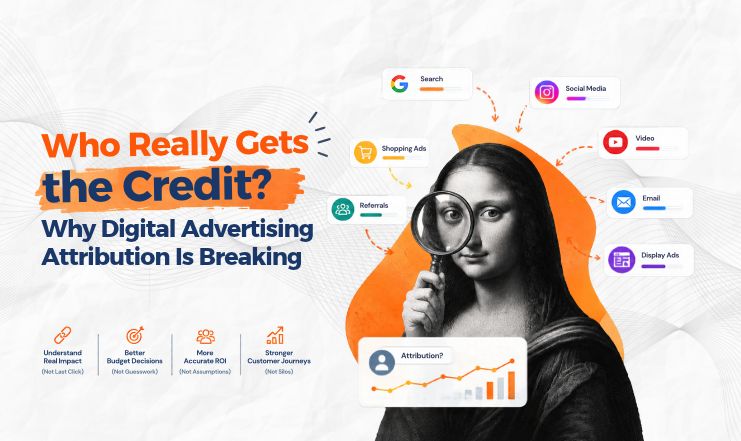
Who Really Gets the Credit? Why Digital Advertising Attribution Is Breaking
Web D School | Expert Economy
A customer rarely sees one ad, clicks it, and immediately buys.
A more realistic journey might look like:
YouTube → Instagram → Google Search → Email → WhatsApp → Purchase
The customer experiences one connected journey. But every platform reports its own contribution. YouTube records a view, Instagram records engagement, Google records a click, WhatsApp records an enquiry, and the CRM records the final sale.
So, who really gets the credit?
The answer is more complicated than most dashboards suggest.
Marketing attribution is useful, but it is not a perfect record of what caused a customer to buy. It is an estimate of how different interactions contributed to the journey.
For marketers, the goal shouldn’t be to find one “winning” channel. It should be to understand how channels work together to create demand, build trust, capture intent, and convert customers.
What Is Digital Advertising Attribution?
Digital advertising attribution is the process of assigning credit to marketing interactions that happen before a conversion.
A conversion could be:
- A purchase
- A qualified lead
- A course enrolment
- A WhatsApp enquiry
- A booking
- A subscription
The challenge is that customers rarely follow a straight path.
For example, someone interested in a digital marketing course might:
- Discover a YouTube video.
- See an Instagram Reel a few days later.
- Search the institute on Google.
- Download a course guide.
- Read an email case study.
- Ask questions on WhatsApp.
- Speak with a counsellor.
- Finally enrol.
Which channel created the sale?
Probably not one channel alone.
That is the central problem with attribution.
7 Reasons Digital Advertising Attribution Is Breaking
1. Customers Don’t Follow a Straight-Line Journey
Traditional marketing reports often make the customer journey look simple:
Ad → Click → Purchase
Real customer behaviour is usually closer to:
Discover → Forget → Discover Again → Search → Compare → Ask → Trust → Buy
A customer might see a brand on Instagram today and search for it on Google two weeks later.
The Google click may be measurable. The earlier Instagram influence may not be.
This creates an important distinction:
The channel that captures the customer is not always the channel that created the customer.
2. Every Platform Wants Credit for the Same Customer
Imagine one customer sees:
- A Meta advertisement
- A YouTube video
- A Google Search advertisement
- An email
- A WhatsApp message
The customer purchases once.
But several systems may report that same customer as a conversion.
If marketers simply add all platform-reported conversions together, one sale can appear to become multiple sales.
This is why platform-reported conversions should not automatically be treated as separate customers or incremental sales.
The CRM and actual revenue should remain the business-level source of truth.
3. Last-Click Attribution Can Create the Wrong Winner
Last-click attribution gives 100% of the credit to the final measurable interaction.
Suppose the journey is:
YouTube → Instagram → Google → Email → WhatsApp → Purchase
WhatsApp gets all the credit.
That sounds convenient.
But YouTube created awareness. Instagram created interest. Google captured active intent. Email built confidence. WhatsApp removed the final hesitation.
The final interaction may have closed the sale without being responsible for the entire journey.
This is why last-click attribution can be useful for reporting while still being incomplete for strategy.
4. First-Touch Attribution Has the Opposite Problem
First-touch attribution gives all the credit to the first interaction.
In the same example, YouTube gets 100% of the credit.
This recognises demand creation but ignores everything that happened afterward.
The first interaction may have introduced the customer, but it may not have answered their questions, built trust, or removed purchase friction.
So first-touch and last-touch attribution answer different questions.
Neither should automatically be treated as the complete truth.
5. Some Important Influences Don’t Produce Clicks
Not every marketing influence is measurable through a link.
A customer might:
- Watch a Reel without clicking.
- See a YouTube video and search the brand later.
- Hear about a company from a friend.
- Read reviews before purchasing.
- Talk to a salesperson.
- Ask a family member for advice.
These interactions can influence decisions without appearing neatly inside an analytics report.
This is one reason attribution is not the same as causation.
A Google ad appearing before a purchase proves that the ad was part of the measurable journey. It does not automatically prove that the ad caused the purchase.
6. Privacy and Cross-Device Behaviour Make Tracking Harder
Customers frequently move between:
TV → Mobile → Laptop → Physical Store
Someone might watch a YouTube video on a TV, research the brand on a phone, and purchase from a laptop.
Privacy protections, consent choices, browser restrictions, and device fragmentation can make it difficult to connect every interaction to the same person.
As a result, some marketing measurement increasingly depends on estimates and modelling rather than complete individual-level tracking.
Even sophisticated attribution can therefore be incomplete.
7. Attribution Models Change the Story
Consider a ₹30,000 course enrolment following:
YouTube → Instagram → Google → Email → WhatsApp
Different attribution models can tell completely different stories.
| Attribution Model | Credit |
| First Touch | YouTube gets 100% |
| Last Click | WhatsApp gets 100% |
| Equal Credit | Each touchpoint gets 20% |
| Data-Driven | Credit is estimated based on observed conversion patterns |
Imagine a data-driven model estimates:
- YouTube — 15%
- Instagram — 15%
- Google — 30%
- Email — 15%
- WhatsApp — 25%
Suddenly, the “winning channel” has changed.
This demonstrates an important principle:
Attribution doesn’t simply reveal reality. The attribution model influences how we interpret reality.
A Better Way to Think About Attribution
Instead of asking:
“Which channel gets the credit?”
Ask:
“What job did each channel perform?”
A simple customer journey can be divided into five roles:
1. Discover
Channels such as YouTube, Instagram, influencers and communities can introduce the brand.
2. Understand
Educational content, blogs, videos and emails help customers understand the offer.
3. Validate
Reviews, testimonials, case studies and social proof help answer:
“Can I trust this?”
4. Compare
Google Search, websites, pricing pages and comparison content help customers evaluate their options.
5. Convert
WhatsApp, sales calls, forms and checkout experiences help remove final friction.
This role-based approach can be more useful than forcing every channel into the same conversion metric.
Demand Creation vs. Demand Capture
One of the most important attribution concepts is the difference between demand creation and demand capture.
Demand Creation
Channels such as:
- YouTube
- Influencers
- Communities
- Educational content
can create awareness and interest.
They make someone think:
“Maybe I need this.”
Demand Capture
Channels such as:
- Google Search
- Google Maps
- Comparison pages
- Brand search campaigns
often capture people who already have intent.
They are responding to:
“I want to find this.”
This explains why Search can appear extremely strong in last-click reports.
Search may be capturing demand that another channel created earlier.
So before cutting an awareness channel because it produces few direct conversions, ask:
Is it creating demand that another channel is later capturing?
First-Party Data Can Make Attribution Better
A strong CRM can provide a valuable reality check.
Businesses can record:
- Original lead source
- Campaign source
- Website activity
- Webinar or event participation
- WhatsApp enquiries
- Qualified lead status
- Final sale
- Revenue
- Customer-reported source
One particularly useful question is:
“How did you first hear about us?”
Then ask:
“What finally convinced you to choose us?”
These are different questions.
A customer might discover a brand through YouTube but make the final decision because of reviews, pricing, or a salesperson.
A dashboard may not capture that distinction.
Marketers learning this broader approach can benefit from a Full Stack Digital Marketing Course, where acquisition, analytics, conversion and customer journeys are understood as connected parts of digital marketing.
Attribution vs. Incrementality: What’s the Difference?
These two concepts are often confused.
Attribution asks:
“Which marketing interaction gets credit for the conversion?”
Incrementality asks:
“What happened because this marketing activity existed that would not have happened otherwise?”
Imagine Instagram reports 100 conversions.
But suppose 90 customers would have purchased anyway.
The incremental impact could be closer to 10 additional conversions.
That’s a very different business conclusion.
For small businesses, simple experiments can provide useful evidence.
For example:
Run campaign → measure results → reduce or pause activity → compare results
You can compare:
- Sales
- Enquiries
- Bookings
- Branded searches
- Website traffic
- Qualified leads
The experiment won’t be perfect, but it can answer a more valuable question:
“Does this activity actually create additional business?”
Build a Practical Attribution System
You don’t need a complicated enterprise system to make better marketing decisions.
A practical setup can include:
1. Platform Data
Use Meta, Google, YouTube and other platforms to understand campaign and creative performance.
2. Analytics
Use website analytics to understand journeys and traffic behaviour.
3. CRM
Track qualified leads, customers and actual revenue.
4. Customer Research
Ask customers how they discovered the business and what influenced their final decision.
5. Experiments
Test what changes when you increase, reduce or pause marketing activity.
Together, these sources provide a much stronger picture than any single attribution dashboard.
If you’re building these skills systematically, a Full Stack Digital Marketing Course can help connect paid advertising, SEO, analytics, content, CRM and conversion into one broader marketing system.
5 Common Digital Advertising Attribution Mistakes
1. Giving Everything to the Last Click
The last interaction is not automatically the reason the customer purchased.
2. Adding Every Platform’s Conversions
Multiple platforms may report the same customer.
Don’t blindly add platform conversion numbers together.
3. Cutting Awareness Too Quickly
A channel can influence future demand without generating immediate last-click conversions.
4. Comparing Channels With Different Jobs
A YouTube awareness video and a branded Google Search ad have fundamentally different roles.
Judging both only by last-click conversions can create bad decisions.
5. Chasing Perfect Attribution
Perfect attribution is unrealistic.
The goal is not to reconstruct every second of a customer’s life.
The goal is to obtain better evidence for better decisions.
A Full Stack Digital Marketing Course can be especially useful for marketers who want to understand how these channels connect rather than managing paid advertising, SEO, content and analytics in isolation.
A Simple Attribution Framework for Small Businesses
If you’re a small business, start with these six steps:
- Track the first known source whenever possible.
- Use consistent UTM parameters across campaigns.
- Record meaningful enquiries in your CRM.
- Track qualified leads and revenue, not only raw leads.
- Ask customers how they discovered and chose you.
- Compare attribution with simple experiments.
Don’t ask only:
“Which channel generated the most conversions?”
Also ask:
- Which channel created awareness?
- Which channel built trust?
- Which channel captured existing demand?
- Which channel removed hesitation?
- Which channel would hurt the journey most if removed?
These questions lead to better marketing decisions.
FAQ: Digital Advertising Attribution
- What is digital advertising attribution?
Digital advertising attribution is the process of assigning credit to marketing interactions that occur before a conversion. It helps marketers understand how channels such as Google, Meta, YouTube, email and other touchpoints contribute to customer journeys.
- What is the best attribution model?
There is no universally best attribution model. First-touch, last-click, equal-credit and data-driven models answer different questions. A strong measurement system compares multiple views instead of treating one model as absolute truth.
- Why is last-click attribution inaccurate?
Last-click attribution gives all conversion credit to the final measurable interaction. It can ignore earlier activities that created awareness, built trust or generated demand.
- What is the difference between attribution and incrementality?
Attribution asks which marketing interactions receive credit for a conversion. Incrementality asks whether the marketing activity caused additional conversions that would not have happened without it.
- Why can Google and Meta both claim the same conversion?
Different advertising platforms use their own tracking and attribution rules. The same customer may interact with several platforms before purchasing, allowing multiple systems to report influence over the same conversion.
- How can small businesses improve attribution?
Small businesses can improve attribution by using consistent tracking, maintaining a CRM, recording lead sources, tracking revenue, asking customers how they discovered the business, comparing first- and last-touch data, and running simple marketing experiments.
- Does attribution prove that an advertisement caused a sale?
No. Attribution estimates contribution based on observable interactions and a chosen measurement model. It does not prove that an individual advertisement caused the purchase.
The Main Lesson
Customers don’t experience marketing as separate dashboards.
They experience one journey.
They discover a brand, see content, search, compare, read reviews, ask questions, speak with people and eventually make a decision.
Attribution is valuable because it helps marketers organise evidence from that complicated journey. But it should never be mistaken for perfect truth.
So when a dashboard says:
“This channel generated the sale.”
Ask:
According to which attribution model?
Then ask:
What happened before that interaction?
The better question isn’t simply “Who closed the sale?”
It’s:
“Who helped create the customer?”
That shift turns attribution from simple reporting into better marketing strategy.