
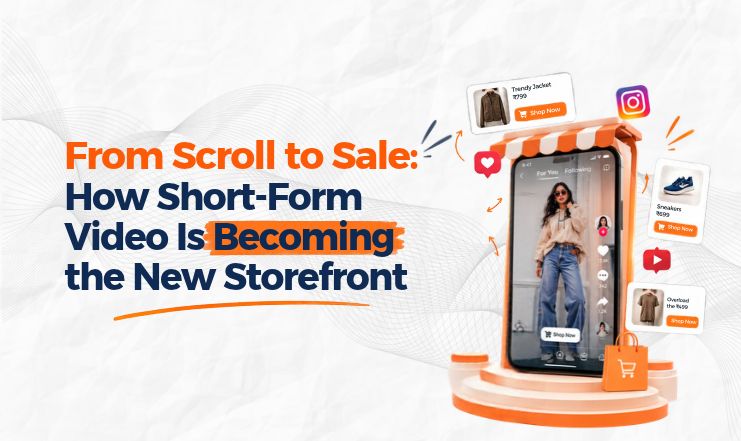
From Scroll to Sale: How Short-Form Video Is Becoming the New Storefront
Web D School | Expert Economy
Short-form video was once mainly about getting attention. Brands created Reels, Shorts, and TikToks to increase views, followers, and awareness.
But that journey is changing.
Today, a customer can discover a product, watch it being demonstrated, read comments, hear a creator’s opinion, and take action without leaving the platform or making a traditional search.
This is the rise of shoppable video.
Short-form video is no longer just content about a product. It is increasingly becoming part of the shopping experience itself.
What Is Shoppable Video?
Shoppable video helps move a viewer through four stages:
See → Understand → Trust → Act
The action could be:
- Tapping a product tag
- Visiting a website
- Sending a WhatsApp message
- Booking a demo
- Registering for a service
- Making a purchase
A strong shoppable video does more than display a product. It introduces a problem, demonstrates the solution, provides proof, and makes the next step simple.
7 Ways Short-Form Video Is Becoming the New Storefront
1. Video Can Show What a Product Actually Does
Traditional product pages depend heavily on images and descriptions. Video can demonstrate the product in seconds.
For example:
- A clothing brand can show how a dress looks while moving.
- A restaurant can show food being prepared and served.
- A gadget brand can demonstrate how a device works.
- A fitness brand can show an exercise machine in use.
- An educational brand can show students working on real projects.
The difference is simple: don’t just show the product—show the benefit.
For someone learning modern marketing, a Full Stack Digital Marketing Course can similarly demonstrate practical skills through real campaign examples instead of simply listing modules.
2. Short-Form Video Creates Demand, Not Just Captures It
Traditional search usually starts with an existing need.
Someone searches:
“Best laptop bag for travel”
Short-form video can work differently.
A person may simply be scrolling and see:
“If your laptop bag feels heavy before you even put your laptop inside, look at this.”
The viewer wasn’t necessarily shopping.
The video created curiosity first.
This is the shift from search commerce to discovery commerce. Search captures existing demand, while short-form video can create interest during everyday content consumption.
3. The Best Shoppable Videos Follow a Simple Formula
A useful structure is:
Hook → Demonstration → Proof → Action
Hook: Give people a reason to keep watching.
Demonstration: Show the product solving a real problem.
Proof: Use reviews, results, demonstrations, comparisons, or authentic experiences.
Action: Give the viewer one clear next step.
For example, instead of saying:
“Our course offers comprehensive digital marketing training.”
A video could show a student building an SEO campaign, creating content, analysing analytics, and explaining what they learned.
This practical approach is especially useful when promoting a Full Stack Digital Marketing Course, because potential students want to understand what they will actually learn and do.
4. Creators Can Become Part of the Product Experience
A product page may tell customers that a shirt is lightweight and comfortable.
A creator can show:
- How it fits
- How it looks while moving
- Whether it wrinkles
- How the sizing feels
- Whether it is suitable for everyday use
The creator becomes part reviewer, demonstrator, and recommender.
That is why creator-led commerce can feel more useful than traditional advertising.
However, trust depends on authenticity. Honest limitations can sometimes make a recommendation more believable than exaggerated praise.
5. Comments Can Reveal Buying Questions
Comments are not only engagement metrics.
They can reveal exactly what prevents someone from buying.
For example:
“Will this work with an iPhone?”
“Is this suitable for beginners?”
“What size should I choose?”
“How long does delivery take?”
Each question can become another piece of content.
A brand can use those questions to create follow-up videos that remove specific buying uncertainties.
This creates a useful content cycle:
Video → Questions → New Video → More Clarity → Purchase
6. One Video Should Usually Have One Main Action
A common mistake is asking viewers to:
- Buy now
- Follow the page
- Comment
- Share
- Download something
- Subscribe
- Visit the website
—all in one video.
That creates friction.
Instead, choose one primary action:
“Tap the product link.”
or
“Send us ‘DEMO’ on WhatsApp.”
or
“Book your trial.”
For educational brands, a Full Stack Digital Marketing Course video might simply ask viewers to “View the syllabus and register for an orientation.”
One clear action is easier to understand and measure.
7. Views Are Not the Same as Sales
A video can receive thousands of views and generate very few customers.
That doesn’t automatically mean the brand needs more views.
The real problem could be:
- The wrong audience
- Weak product demonstration
- Poor proof
- Confusing pricing
- Complicated checkout
- A weak CTA
- A broken link
- A product that wasn’t clearly explained
Therefore, marketers should measure the complete journey.
| Stage | Useful Metrics |
| Attention | Views, retention, completion rate |
| Interest | Saves, shares, profile visits |
| Shopping Intent | Product taps, messages, add-to-cart |
| Conversion | Purchases, bookings, revenue |
| Quality | Refunds, complaints, customer feedback |
A strong video should not only generate attention. It should help the right audience move closer to a decision.
A Simple 30-Second Shoppable Video Structure
You don’t need a complicated script.
| Time | Section | Purpose |
| 0–3 sec | Hook | Stop the scroll |
| 3–12 sec | Demonstration | Show the solution |
| 12–22 sec | Proof | Build trust |
| 22–30 sec | CTA | Tell viewers what to do |
For example, a digital marketing workshop could begin with:
Hook: “Confused about which digital marketing skill to learn first?”
Demonstration: Show a simple path from SEO → Content → Analytics → Campaign Practice.
Proof: Show real student project work.
CTA: “View the syllabus and register for the orientation.”
The goal isn’t to explain the entire programme. It is to solve one specific problem.
Product Video vs. Product Advertisement
These two formats serve different purposes.
A traditional advertisement may focus on:
- Brand awareness
- Emotional storytelling
- Reach
- Brand positioning
A shoppable video focuses more on:
- A specific problem
- A specific product
- A visible benefit
- Proof
- A clear next step
Brands may need both.
The mistake is expecting every short-form video to perform every marketing job at once.
Don’t Turn Every Reel Into “Buy Now”
Shoppable video creates a temptation to make every piece of content aggressively promotional.
That can damage trust.
Some videos should:
- Educate
- Demonstrate
- Compare
- Answer questions
- Remove doubts
The purchase may happen later.
A better question is:
“What buying uncertainty can this video remove?”
rather than:
“What can we sell immediately?”
Common Short-Form Video Mistakes
1. Starting With the Brand
“Welcome to Webd Company, established in 2018…”
Start with the customer’s problem instead.
2. Listing Features Without Context
A feature matters only when people understand the benefit.
3. Showing Instead of Demonstrating
A product sitting on a table is less useful than seeing it solve a real problem.
4. Trying to Sell Everything
Thirty seconds isn’t a product catalogue.
5. Using Too Many CTAs
Give viewers one obvious next step.
6. Creating Fake Urgency
“Only two left!” should be true. False scarcity can damage long-term trust.
7. Over-Producing Every Video
A simple, authentic demonstration can sometimes outperform an expensive production.
The SPARK Approach: Reconstruct the Video
Short-form video isn’t about squeezing more information into less time.
It is about deciding what deserves to remain.
A first draft might contain:
- Brand history
- Six features
- Three testimonials
- Pricing
- Discounts
- Multiple CTAs
Instead, reconstruct it around:
One problem → One demonstration → One proof point → One action
Then test different versions.
Change one variable at a time:
- Hook
- Speaker
- Demonstration
- Proof
- CTA
This helps marketers understand what actually influences audience response.
The Ethics of Shoppable Video
When entertainment and shopping become connected, trust becomes even more important.
Brands and creators should avoid:
- Fake demonstrations
- Invented results
- Misleading before-and-after claims
- False scarcity
- Hidden sponsorships
- Exaggerated product claims
The closer a video feels to a genuine recommendation, the more important honesty becomes.
Trust is one of the main reasons shoppable video works in the first place.
The Bigger Shift: From Content to Commerce
The traditional journey looked something like:
Content → Search → Product Page → Purchase
The new journey can be much shorter:
Video → Understand → Trust → Act
Short-form video can now function as:
- A product catalogue
- A demonstration space
- A review environment
- A discovery channel
- A sales interface
That changes the creative brief.
Instead of asking:
“How do we make an engaging Reel?”
Marketers should ask:
“What buying uncertainty can this video remove?”
That question leads to more useful content and better commercial outcomes.
Frequently Asked Questions
What is shoppable video?
Shoppable video is video content that helps viewers move from discovering a product to taking an action such as viewing a product, sending a message, booking a service, or making a purchase.
Why is short-form video effective for e-commerce?
Short-form video can demonstrate products quickly, create demand, provide social proof, and reduce uncertainty before purchase.
What makes a short-form video shoppable?
A strong shoppable video usually combines a relevant hook, product demonstration, credible proof, and one clear call to action.
Should every short-form video include a sales CTA?
No. Some videos should focus on education, demonstrations, comparisons, or answering customer questions. Not every video needs to push an immediate purchase.
How should brands measure shoppable video?
Brands should look beyond views. Useful metrics include retention, saves, shares, product clicks, messages, add-to-cart actions, purchases, revenue, refunds, and customer complaints.
Can short-form video replace a product page?
Usually, no. Video can reduce uncertainty and demonstrate the product, but detailed information, pricing, specifications, policies, and other purchase information may still require a product page or another conversion channel.
What is the biggest mistake brands make with shoppable videos?
Trying to communicate too much. The strongest videos usually focus on one customer problem, one useful demonstration, one proof point, and one action.
Final Takeaway
Short-form video is evolving from an attention format into a shopping and decision-making experience.
The strongest videos don’t simply make viewers think:
“I want that.”
They help viewers answer:
“Is this actually right for me?”
That is the real power of shoppable video.
The goal isn’t to make every video feel like an advertisement. It is to make the video useful enough that the viewer can understand the product, trust the evidence, reduce uncertainty, and confidently decide what to do next.