
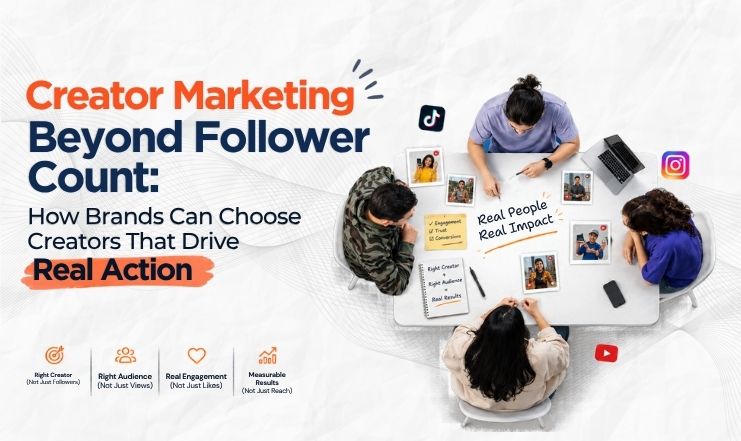
Creator Marketing Beyond Follower Count: How Brands Can Choose Creators That Drive Real Action
Web D School | Expert Economy
For years, brands selected creators based on one obvious metric: follower count. But a large audience does not automatically mean influence.
A creator with 25,000 highly relevant followers may generate more qualified enquiries than a creator with 1 million followers who has little connection with the product.
Modern creator marketing is therefore shifting from buying reach to building trust, relevance, and action.
The better question is not “Who has the most followers?” but:
“Whose audience is most likely to trust this recommendation and take the next step?”
Here are 9 practical ways to approach creator marketing beyond follower count.
1. Choose the Creator Based on the Campaign Goal
Before searching for creators, define what you want them to accomplish.
A creator might be responsible for:
- Discovery – introducing the brand to a new audience
- Education – explaining a complicated product or service
- Demonstration – showing how a product works
- Trust building – providing a credible personal opinion
- Local influence – reaching a specific city or community
- Conversion – generating enquiries, bookings, or sales
For example, a skincare brand could work with an expert creator to explain ingredients, a lifestyle creator to demonstrate daily usage, and a customer-style creator to make the experience relatable.
The right creator depends on the job, not simply their audience size.
2. Look at Audience Relevance, Not Just Audience Size
Follower count measures potential distribution. It does not tell you whether those followers are the right people.
Consider:
- Location
- Age group
- Language
- Interests
- Purchasing power
- Professional background
- Customer intent
For example, a Chennai children’s learning brand may gain more from a Tamil parenting creator with 35,000 relevant followers than from a national creator with 2 million followers.
This is the difference between audience size and audience concentration.
A smaller but highly relevant audience can create stronger business results than a much larger general audience.
3. Evaluate Creator Credibility and Content Fit
People follow creators for different reasons. Some trust their expertise, while others follow their personality, lifestyle, entertainment value, or opinions.
Ask two important questions:
Why does this audience trust this creator?
Does that credibility match the product?
A finance creator may have strong credibility when discussing investments but not necessarily when reviewing skincare products.
Content style matters too. A technical product may require explanation, while a fashion product may need visual demonstration.
The creator’s usual content should make the brand integration feel natural rather than forced.
This principle is particularly important for marketers learning how different channels, content formats, and customer journeys work in a Full Stack Digital Marketing Course. Creator campaigns work best when they are connected to the wider marketing funnel rather than treated as isolated social posts.
4. Measure Engagement Quality Instead of Counting Likes
A post with thousands of likes is not automatically successful.
Compare these two types of comments:
- “Amazing! 🔥”
- “Will this work for beginners?”
- “Where can I buy this?”
- “Does this work in Chennai?”
- “How much does it cost?”
The second group provides stronger evidence of customer intent.
Engagement should therefore include:
- Meaningful comments
- Saves
- Shares
- Direct enquiries
- Clicks
- Profile visits
- Qualified leads
- Conversions
A basic engagement rate can be calculated as:
Engagement Rate = Interactions ÷ Reach × 100
However, engagement rate should be treated as one signal rather than the complete measure of creator performance.
5. Understand What You Are Actually Paying For
Not every creator partnership is simply “one sponsored post.”
A creator can provide different types of value:
| Creator partnership | Primary value |
| UGC-style content | Content asset |
| Organic endorsement | Trust + distribution |
| Paid usage rights | Reusable advertising content |
| Affiliate partnership | Performance-based sales |
| Long-term partnership | Repeated familiarity and trust |
For example, a brand may pay a creator to produce a video and separately negotiate permission to use that video in paid advertising.
Usage rights matter because content created for one platform cannot automatically be assumed to be available for every future marketing purpose.
Brands should define exactly where, how long, and in what format creator content can be reused.
6. Ask Creators to Demonstrate, Not Just Praise
“This product is amazing” provides very little useful information.
A demonstration is much more persuasive.
Good creator content can answer questions such as:
- How does the product work?
- Who is it suitable for?
- What problem does it solve?
- What does the experience actually look like?
- Who might not need it?
- What are its limitations?
For example, instead of saying:
“This is the best laptop for everyone.”
A creator might explain:
“This works well for everyday design and marketing work, but I wouldn’t recommend it for heavy 3D rendering.”
That type of balanced explanation can feel more credible because it helps the audience make a decision rather than simply promoting the product.
7. Give Creators Strategic Direction Without Over-Scripting
A strong creator brief should provide clarity without destroying authenticity.
Include:
- Campaign objective
- Target audience
- Problem to address
- Core product truth
- Mandatory information
- Pricing or offer details
- Disclosure requirements
- CTA
- Measurement method
At the same time, allow the creator to decide:
- Hook
- Story
- Presentation style
- Natural language
- Personal experience
- Video format
A 700-word script that forces a creator to speak like a brand advertisement defeats the purpose of creator marketing.
The better approach is:
Brand provides the strategy and boundaries. Creator provides the natural expression.
8. Measure the Full Customer Journey
Creator influence does not always produce an immediate click.
A customer might:
Watch a Reel → remember the brand → search for it later → visit the website → compare options → purchase.
If a marketer measures only the creator’s direct link, much of this influence can disappear from the report.
Measure both:
Direct impact
- Link clicks
- Promo-code usage
- Enquiries
- Bookings
- Leads
- Sales
Assisted impact
- Branded search growth
- Direct traffic
- Website visits
- Customer Satisfaction
- Assisted conversions
A useful measurement framework is:
Reach → Attention → Trust → Action → Business Value
For example, instead of reporting only:
“The creator’s Reel generated 100,000 views.”
A stronger report would say:
“The Reel reached 100,000 people, generated 240 enquiries and contributed to 12 enrolments, while customer feedback also showed that several buyers discovered the brand through the creator before converting through Search.”
9. Build a Creator Portfolio Instead of Betting on One Influencer
A single large creator is not always the best strategy.
Brands can combine creators with different roles:
- Macro creator: Broad awareness
- Micro creators: Niche credibility
- Nano creators: Local relevance
- Expert creators: Education and authority
- Customer-style creators: Relatability
Consider a restaurant in Anna Nagar. A Chennai food creator with 60,000 highly relevant followers may be more valuable than a national entertainment creator with 2 million followers whose audience cannot realistically visit the restaurant.
This is contextual influence: the value of an audience depends on whether it can actually act on the recommendation.
A Simple Creator Selection Framework
Instead of choosing creators based on follower count alone, evaluate them using five factors:
1. Audience Fit
Does the creator reach the people you actually want to attract?
2. Credibility
Does the audience trust the creator on this particular subject?
3. Content Fit
Can the creator naturally demonstrate or explain the product?
4. Brand Fit
Does the creator’s personality, values, and previous content align with the brand?
5. Commercial Fit
Can the expected business value justify the investment?
A simple scoring model can make creator selection more objective.
For a local business, geography may receive the highest weight.
For a technical product, credibility may matter more.
For a product designed primarily for visual discovery, content quality and demonstration ability may deserve greater importance.
Example: Creator Marketing for a Digital Marketing Institute
Imagine a Chennai digital marketing institute wants to increase orientation registrations among final-year students concerned about how AI is changing careers.
Instead of hiring one large entertainment creator, the institute could work with three creators:
Career creator: Explains whether digital marketing remains a realistic career option.
Marketing professional: Shows what beginner-level marketing work actually looks like.
Student creator: Shares a relatable Chennai-focused perspective.
The central message remains consistent, but each creator performs a different role.
The campaign can then measure:
- Career creator → retention and branded searches
- Marketing professional → portfolio-page visits
- Student creator → Chennai registrations
This approach is more useful than judging every creator using the same metric.
Common Creator Marketing Mistakes
Avoid these mistakes when planning creator campaigns:
- Choosing creators only by follower count – large reach does not guarantee relevance.
- Ignoring audience geography – especially harmful for local businesses.
- Over-scripting content – makes the creator sound like an advertisement.
- Having no defined creator role – makes the campaign difficult to measure.
- Focusing only on likes – likes do not always indicate purchase intent.
- Ignoring comment quality – genuine questions can reveal stronger intent.
- Hiding sponsorships – transparency is essential for audience trust.
- Ignoring usage rights – valuable content may not be reusable without permission.
- Measuring only the creator – landing pages, offers, and sales processes also affect results.
- Running one-off campaigns without learning – every campaign should improve the next one.
The Future of Creator Marketing
AI can help brands identify potential creators, analyse content themes, compare audience data, and create campaign briefs. But technology should not completely replace human judgment.
Cultural understanding, reputation, tone, credibility, and audience trust still require careful evaluation.
As AI-generated content and synthetic personalities become more common, transparency may become even more important.
The future of creator marketing is therefore not simply about finding bigger audiences. It is about finding the right combination of:
Relevant audience + credible creator + useful content + authentic demonstration + measurable action.
Final Takeaway
Creator marketing has moved beyond the traditional celebrity → reach → awareness model.
A more useful model is:
Creator → Relevant Audience → Trust → Demonstration → Action → Business Value
A large creator may generate more impressions. A smaller creator may generate better conversations, stronger enquiries, and more qualified customers.
So before hiring a creator, don’t ask only:
“How many followers do they have?”
Ask:
“Why would this audience believe them, and what evidence shows that belief can become action?”
That is the difference between buying reach and building influence.
Frequently Asked Questions About Creator Marketing
1. What is creator marketing?
Creator marketing is a strategy where brands collaborate with content creators who have built trust and influence within a specific audience. The creator may introduce, demonstrate, explain, review, or recommend a product or service.
2. Is follower count important in creator marketing?
Follower count is useful for estimating potential reach, but it should not be the main selection criterion. Audience relevance, credibility, engagement quality, content fit, geography, and business results can matter more.
3. Are micro-creators better than large influencers?
Not always. Micro-creators can be highly effective for niche communities, local businesses, and specialised products, while large creators may be more suitable for national awareness campaigns. The best choice depends on the campaign objective.
4. How do brands measure creator marketing success?
Brands can measure direct results such as clicks, leads, bookings, promo-code usage, and sales. They should also consider assisted impact such as branded search, direct traffic, and customers reporting the creator as their discovery source.
5. What makes a creator credible?
Credibility comes from the relationship between the creator, their expertise or experience, their content, and their audience. A creator is more credible when their recommendation naturally fits the subject they regularly discuss.
6. What should brands include in a creator brief?
A creator brief should include the objective, audience problem, core message, mandatory information, disclosure requirements, CTA, and measurement method. Creators should retain reasonable freedom over the hook, story, and presentation style.
7. Why is demonstration better than simple product praise?
Demonstration gives audiences practical information about how a product works and whether it suits their needs. It helps people evaluate the product instead of simply hearing promotional claims.
8. What is the biggest mistake in creator marketing?
One of the biggest mistakes is choosing a creator based primarily on follower count. Large reach without audience relevance or trust can generate impressions without meaningful business results.
9. Should brands use multiple creators?
Often, yes. A portfolio of large, micro, nano, expert, and customer-style creators can allow a brand to combine awareness, niche credibility, local relevance, education, and conversion-focused content.
10. How is creator marketing different from traditional influencer marketing?
Influencer marketing often focuses heavily on audience reach and influence. Creator marketing places greater emphasis on the person’s ability to create useful content, build community, demonstrate products, and contribute to different stages of the customer journey.