
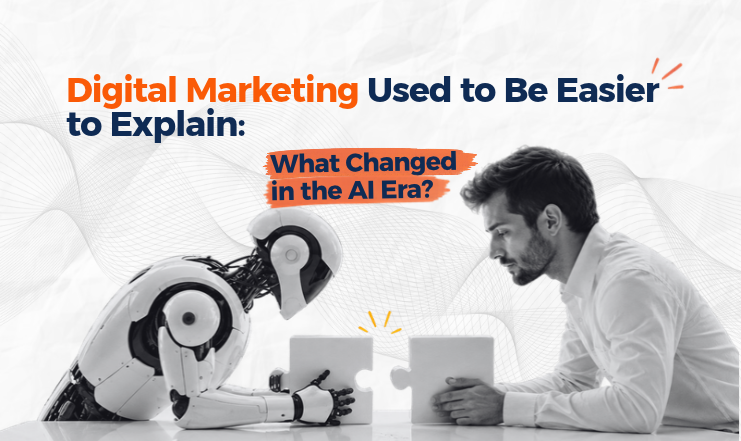
Digital Marketing Used to Be Easier to Explain: What Changed in the AI Era?
Web D School | Expert Economy
Digital marketing used to be easier to explain. Search brought visitors. Social media built audiences. Content created engagement. Advertising generated leads. Websites converted them.
That simple model no longer describes how people discover and buy from brands.
Today, a customer might discover a brand through a creator, search for it on Google, watch a YouTube video, compare reviews, ask an AI assistant for recommendations, join a community, send a WhatsApp message, and eventually make a purchase. The journey can involve several channels, devices, conversations, and decisions.
At the same time, artificial intelligence is changing how marketing work gets done. AI can generate content, analyse data, identify patterns, answer customer questions, qualify leads, personalise communication, and automate repetitive tasks. Understanding how these channels and technologies work together is an important part of a Full Stack Digital Marketing Course, where learners can develop practical skills across digital marketing disciplines.
The tools are becoming easier. The decisions are becoming harder.
This raises a more important question for modern marketers:
What problem are we solving, for whom, and how will we know whether our decision worked?
Here are 10 major changes that explain why digital marketing is harder to define—and why marketers need to think differently in the AI era.
1. The Digital Marketing Funnel Is No Longer a Straight Line
The traditional digital marketing model was relatively simple:
Search → Website → Lead → Conversion
Or:
Social Media → Content → Engagement → Purchase
Customers today rarely follow one predictable path.
A person might:
- See a creator recommending a product.
- Search for the brand on Google.
- Watch a product review on YouTube.
- Read customer reviews.
- Ask ChatGPT or another AI assistant for alternatives.
- Visit the company’s website.
- Leave without purchasing.
- See a retargeting advertisement.
- Send a WhatsApp message.
- Finally make a purchase.
The important point is that the customer journey is now fragmented across multiple discovery and decision environments.
This means marketers should not optimise every channel independently.
Instead, they need to understand how different touchpoints work together.
What this means for marketers
Don’t ask only:
“Which channel generated the conversion?”
Also ask:
- Where did the customer first discover the brand?
- What helped them evaluate it?
- Which interaction built trust?
- What information reduced uncertainty?
- Which channel assisted the final decision?
- Did the customer already know the brand before clicking the advertisement?
Modern digital marketing is increasingly about understanding the entire customer journey, not just the last click.
2. Search Is Becoming More Than a List of Blue Links
Search marketing used to focus heavily on ranking webpages for keywords.
The basic objective was:
Keyword → Search Result → Website Click
That remains important, but search behaviour is expanding.
People now expect search engines and AI systems to provide direct answers, summaries, comparisons, recommendations, and explanations.
Instead of searching:
“Best CRM software”
a user may ask:
“Which CRM is best for a small business with a five-person sales team and a limited budget?”
The second query requires more context.
This creates a major opportunity for marketers who produce useful, structured, trustworthy information.
Your content needs to answer questions clearly rather than simply repeat keywords.
What modern search visibility requires
Strong search content should generally:
- Answer the primary question directly.
- Explain concepts clearly.
- Cover related questions.
- Provide useful examples.
- Demonstrate expertise.
- Use logical headings.
- Include relevant supporting information.
- Avoid unnecessary keyword repetition.
- Make important facts easy to identify.
The goal is no longer simply to rank a webpage.
The broader goal is to become a useful source of information wherever people search and ask questions.
3. AI Has Changed the Meaning of Marketing Automation
Automation previously meant things such as:
- Scheduling social media posts.
- Sending email sequences.
- Moving leads between CRM stages.
- Triggering notifications.
- Generating reports.
AI expands the possibilities considerably.
Modern AI systems can assist with:
- Content creation.
- Customer research.
- Data analysis.
- Lead qualification.
- Personalisation.
- Customer support.
- Market research.
- Campaign analysis.
- Idea generation.
- Experiment design.
- Workflow execution.
This creates an important distinction.
Automation can execute a predefined process.
AI can increasingly help interpret information and perform tasks that previously required human judgement.
But this does not mean marketers should simply hand over decisions to AI.
AI may produce something quickly without understanding whether that output is strategically appropriate.
For example, an AI system can generate 100 social media posts.
The more important question is:
Should you publish those 100 posts in the first place?
Quantity is not the same as value.
4. The Marketer’s Job Is Moving From Producing to Deciding
As AI makes content production faster, producing more content becomes less of a competitive advantage.
If almost every business can generate:
- Blog posts
- Social captions
- Ad copy
- Images
- Videos
- Emails
- Product descriptions
then simply producing more of them will not necessarily create differentiation.
The valuable skill becomes decision-making.
A marketer needs to decide:
- What should we create?
- Who needs it?
- Why would they care?
- What problem does it solve?
- What evidence supports the idea?
- Which channel should carry it?
- What should success look like?
- What should we change if it does not work?
This creates a new marketing principle:
AI can increase the speed of execution, but human judgement determines whether the execution is worth doing.
The future marketer therefore needs both technical fluency and strategic thinking.
5. Content Needs to Add Something Distinctive
The internet already contains enormous amounts of content.
AI has made it even easier to create more.
That means publishing another generic article on a familiar topic is unlikely to be enough.
For content to stand out, it should add something useful or distinctive.
That might include:
- Original research.
- First-hand experience.
- Real examples.
- Unique frameworks.
- Expert analysis.
- Case studies.
- Data interpretation.
- Practical processes.
- Contrarian but defensible insights.
- Lessons from experiments.
Consider two articles about improving advertising performance.
One says:
“Improve your ROAS by targeting the right audience and creating better ads.”
Another explains a real campaign where platform ROAS looked healthy, but contribution margin showed the business was still below break-even.
The second provides something more valuable:
context, evidence and reasoning.
This is increasingly important in both traditional search and AI-driven discovery.
6. Social Media Is No Longer Just About Building Followers
The old social media model often focused on:
Followers → Engagement → Reach
Follower count still matters in some contexts, but it is not a complete measure of marketing value.
A smaller creator or community may generate more meaningful business results than a large account if its audience has stronger relevance and trust.
For example, a creator with 20,000 highly relevant followers may be more valuable to a specialist brand than a creator with 500,000 unrelated followers.
Understanding how to evaluate audience relevance, build trust, and measure campaign performance is an important part of a Full Stack Digital Marketing Course.
Modern creator and social strategies should therefore consider:
- Audience relevance.
- Trust.
- Engagement quality.
- Content fit.
- Brand alignment.
- Expertise.
- Conversion influence.
- Community relationships.
The important question is not:
“How many people follow this creator?”
It is:
“Why would this audience trust this person when making a decision?”
That shift moves influencer marketing away from simple reach and toward relevance and credibility.
7. Communities and Conversations Are Becoming More Important
Not every customer interaction happens on a company’s website.
Customers increasingly communicate through:
- WhatsApp.
- Social messaging.
- Online communities.
- Discussion forums.
- Private groups.
- Comments.
- Reviews.
- Creator communities.
These environments can influence purchasing decisions long before a customer reaches a checkout page.
Someone may ask:
“Has anyone used this product?”
That conversation may influence the purchase more than a polished advertisement.
This makes community and conversational marketing increasingly important.
Brands need to think beyond broadcasting messages.
They also need to listen, respond and participate.
A useful modern marketing framework is:
Publish → Listen → Respond → Learn → Improve
The customer conversation itself becomes a source of marketing intelligence.
8. First-Party Data Is Becoming More Valuable
As privacy expectations, platform restrictions and tracking limitations evolve, businesses cannot depend entirely on external platforms to understand customers.
First-party data becomes increasingly valuable.
Examples include:
- Email subscribers.
- Customer purchase history.
- Website interactions.
- CRM records.
- Product preferences.
- Customer feedback.
- Support conversations.
- Loyalty programme activity.
- Permission-based messaging data.
The key word is permission.
Collecting data is not enough.
A strong first-party data strategy can help businesses understand:
- Who their customers are.
- What they purchase.
- How often they purchase.
- What problems they have.
- Which products interest them.
- What messages resonate with them.
This creates a more sustainable foundation for personalisation and customer relationships.
9. Marketing Measurement Must Move Beyond Clicks and Likes
Digital marketing created an enormous advantage: measurable activity.
But measurement can also create a problem.
Businesses can become obsessed with metrics simply because they are easy to see.
Examples include:
- Impressions.
- Clicks.
- Likes.
- Followers.
- Website traffic.
- Leads.
- Cost per click.
- ROAS.
These metrics can be useful.
But a visible metric is not automatically a valuable business metric.
For example, a campaign can generate thousands of clicks but very few profitable customers.
A campaign can have a strong ROAS but still fail to generate enough contribution after variable costs.
A social post can receive hundreds of likes without producing meaningful business impact.
Therefore, modern marketers should connect marketing metrics to business outcomes.
Depending on the business, this may include:
- Revenue.
- Contribution margin.
- Customer acquisition cost.
- Customer lifetime value.
- Retention.
- Repeat purchases.
- Qualified pipeline.
- Profitability.
- Incremental revenue.
The key question becomes:
“What does this metric actually tell us about the business?“
And equally important:
“What does this metric fail to tell us?“
That second question is often where better marketing decisions begin.
10. The Most Valuable Marketing Skill Is Learning How to Think
Platforms will change.
Algorithms will change.
AI tools will change.
Advertising interfaces will change.
Search behaviour will change.
New platforms will appear and existing ones will become less important.
Because of this, marketers cannot build their entire careers around knowing one particular tool.
The durable advantage is the ability to understand problems, question assumptions, interpret evidence and adapt.
This is where the SPARK thinking framework becomes useful.
S — Intent
What are we really trying to achieve?
Before selecting a platform or campaign type, define the actual objective.
Is the goal:
- Awareness?
- Leads?
- Sales?
- Retention?
- Customer education?
- Market research?
- Brand preference?
A clear objective prevents activity from becoming mistaken for progress.
P — Spot the Unseen
What deeper problem might we be missing?
A falling conversion rate might not be an advertising problem.
It could be:
- Poor positioning.
- Weak landing-page messaging.
- Pricing.
- Product-market mismatch.
- Lack of trust.
- Slow response time.
Look beyond the visible metric.
A — Probe the Obvious
Which assumption are we accepting too quickly?
For example:
“Our ROAS is low, so our ads are bad.”
Maybe.
But perhaps the real issue is:
- Poor margins.
- Low average order value.
- Weak conversion after the click.
- High cancellations.
- Low repeat purchase rates.
Question the first explanation.
R — Reconstruct
What should be removed, rearranged or rebuilt?
Sometimes optimisation means changing the entire approach.
Instead of asking:
“How can we improve this campaign?”
ask:
“If we were building this from scratch today, what would we do differently?”
This can reveal opportunities that small optimisations miss.
K — Keep Iterating
What did we learn, and how can the next version become better?
Marketing is rarely solved permanently.
You test.
You observe.
You learn.
You change.
Then you test again.
The goal is not to create one perfect campaign.
The goal is to create a learning system.
What Does Digital Marketing Mean in the AI Era?
Digital marketing in the AI era is the process of using digital channels, data, technology, content, human insight and increasingly AI-powered systems to help businesses attract, understand, convert and retain customers.
But that definition needs an important qualification.
Modern digital marketing is not simply about using more tools.
It is about making better decisions across an increasingly complex customer journey.
A marketer may use:
- SEO.
- Search advertising.
- Social media.
- Content marketing.
- Email.
- Influencer marketing.
- Communities.
- Conversational marketing.
- CRM.
- Analytics.
- Automation.
- AI.
The tools are different ways of solving problems.
The strategy comes before the tool.
Why Are Digital Marketing Tools Becoming Easier While Marketing Decisions Are Becoming Harder?
AI is reducing the effort required for many marketing tasks.
Generating a first draft, analysing a dataset, creating variations of an advertisement or summarising customer feedback can happen much faster.
But easier execution creates more choices.
When producing one campaign required significant effort, teams naturally had to prioritise.
When AI makes it possible to create dozens of variations quickly, the challenge becomes deciding:
Which variations deserve to exist?
This creates an important paradox:
As marketing execution becomes easier, strategic judgement becomes more valuable.
The future marketer therefore needs to understand not only how to use AI, but also when to use it, when not to use it, and how to evaluate its output.
What Should Marketers Learn First in the AI Era?
Marketers should not begin by trying to master every new AI tool.
A stronger learning path is:
1. Understand the customer
Know who the audience is, what they need, what prevents them from buying and how they make decisions.
2. Understand marketing fundamentals
Learn positioning, customer journeys, content, search, persuasion, measurement and experimentation.
3. Learn how digital channels work
Understand the strengths and limitations of search, social, email, advertising, communities and other channels.
4. Learn data interpretation
Know how to distinguish useful signals from misleading metrics.
5. Learn AI as a capability
Use AI to accelerate research, analysis, creation, automation and experimentation.
6. Develop judgement
Ask whether the work is strategically useful—not simply whether it can be produced.
The Future of Digital Marketing Is Not About More Tools
The digital marketing industry will continue to produce new platforms, AI models, automation systems and analytics technologies.
Some will become essential.
Others will disappear.
That is why marketers should avoid defining their expertise only by the tools they know.
A more durable skill set includes:
- Customer understanding.
- Strategic thinking.
- Critical reasoning.
- Content judgement.
- Data interpretation.
- Experimentation.
- Ethical decision-making.
- Adaptability.
- AI literacy.
The strongest marketer will not necessarily be the person who knows the most tools.
It may be the person who can look at a changing environment and ask:
What actually matters here?
That is the central idea behind Beyond the Click.
The objective is not simply to see what happened.
It is to understand why it happened, what the visible metric does not explain, and what should happen next.
Frequently Asked Questions About Digital Marketing in the AI Era
1. Why is digital marketing harder to explain today?
Digital marketing has become harder to define because customers no longer follow a simple journey from search to website to purchase. They can discover brands through creators, search engines, social media, reviews, communities, messaging platforms and AI assistants before making a decision.
2. What has changed in digital marketing because of AI?
AI has made many marketing tasks faster, including content generation, data analysis, customer support, research, personalisation and automation. As execution becomes easier, marketers increasingly need strong judgement to decide what should be done and whether it creates business value.
3. Is SEO still important in the AI era?
Yes. SEO remains important because people continue to use search engines to discover information, products and services. However, modern SEO increasingly requires useful, trustworthy and well-structured content that can answer questions clearly across traditional search and emerging AI-driven discovery experiences.
4. Will AI replace digital marketers?
AI can automate and accelerate many marketing tasks, but it does not eliminate the need for human strategic judgement. Marketers still need to understand customers, define objectives, evaluate evidence, make decisions and take responsibility for the outcomes.
5. What skills should a digital marketer learn in the AI era?
Important skills include customer research, content strategy, SEO, data interpretation, experimentation, analytics, marketing fundamentals, AI literacy, critical thinking and strategic decision-making.
6. Is creating more content enough to succeed in digital marketing?
No. AI has made content production easier, which means volume alone is less distinctive. Successful content should provide useful information, original insights, real examples, experience, evidence or a clear perspective that helps the audience make a decision.
7. Why is first-party data important for modern marketers?
First-party data helps businesses understand customers through information collected directly through permission-based relationships, such as purchases, subscriptions, CRM interactions and customer feedback. It can support better personalisation, retention and customer understanding.
8. Should marketers focus on followers, clicks and likes?
These metrics can provide useful signals, but they should not be treated as the final measure of marketing success. Businesses should also evaluate metrics connected to outcomes such as qualified leads, revenue, contribution margin, retention, repeat purchases and profitability.
9. What is the SPARK framework in digital marketing?
SPARK is a thinking framework designed to help marketers make better decisions. It focuses on Intent, Spot the Unseen, Probe the Obvious, Adapt Across Worlds, Reconstruct and Keep Iterating. The framework encourages marketers to question assumptions, identify deeper problems and continuously improve their approach.
10. What is the most important digital marketing skill for the future?
The most durable skill is the ability to think clearly and make good decisions in changing environments. Tools, platforms and algorithms will continue to change, but understanding customers, questioning assumptions, interpreting evidence and adapting strategies will remain valuable.
Final Takeaway
Digital marketing used to be easier to explain because the customer journey appeared more predictable.
Today, customers move between search, social media, creators, communities, reviews, websites, messaging platforms and AI systems.
At the same time, AI is making marketing execution faster and easier.
That creates a new challenge.
The competitive advantage is shifting from producing more marketing activity to making better marketing decisions.
The modern marketer therefore needs to think beyond:
“Which tool should I use?”
and ask:
“What problem am I solving?”
“What does the customer actually need?”
“What assumption might be wrong?”
“What does the data really tell me?”
“What is the business outcome?”
“What should I test next?”
That is the thinking required to move beyond the click.
The future of digital marketing will not belong only to marketers who can operate the newest tools.
It will belong to marketers who can see clearly when everything around them is changing.