
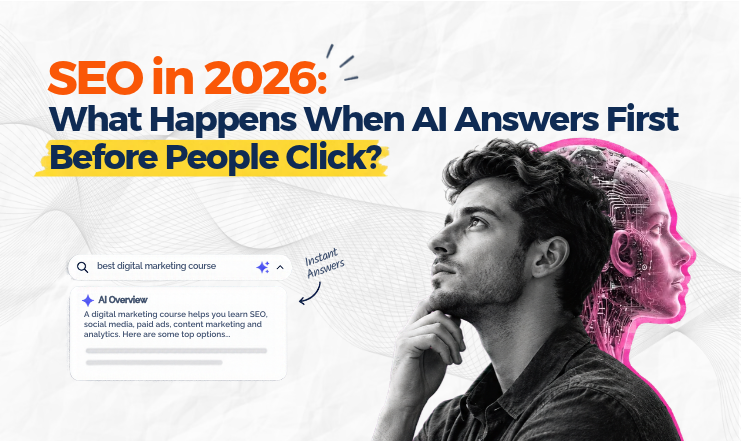
SEO in 2026: What Happens When AI Answers Before People Click?
Web D School | Expert Economy
For years, online discovery followed a predictable journey:
Search query → Search results → Website click → Conversion
That journey is changing.
People can now ask AI-powered search engines detailed questions, receive direct answers, compare different options, ask follow-up questions, and sometimes make decisions without visiting the websites that provided the information.
This does not mean SEO is dead.
It means SEO is becoming broader than rankings and website traffic.
In 2026, businesses need to think about how people discover them, how they evaluate information, where they compare alternatives, and what makes them trust a brand enough to take action.
The important question is no longer only:
“How do I rank for this keyword?”
It is increasingly:
“How can my brand become useful and trustworthy when someone is searching for an answer or making a decision?”
Here are 8 major ways discovery is changing in the AI-search era.
1. Search Results Are Becoming Answers
Traditional search engines primarily presented a list of webpages.
A user searched for something, scanned the results, clicked a link, and found the answer on a website.
AI-powered search changes that experience.Search engines can now generate summaries that answer questions directly. They can combine information from multiple sources, compare different possibilities, and provide follow-up questions.
For example, consider this search:
“Which digital marketing skills should I learn in 2026 to get an entry-level job?”
A traditional search result might show:
- Digital marketing blogs
- Course pages
- YouTube videos
- Job portals
- Training institutes
- Career guides
An AI-powered search experience may instead provide:
- The most important digital marketing skills
- A comparison of SEO, content marketing, paid advertising and analytics
- The role of AI tools
- Suggested learning paths
- Supporting sources
- Follow-up questions
The user may still click a website.
But the click may happen later in the decision journey — or may not happen at all.
What does this mean for SEO?
Your website is no longer competing only to occupy a position in a search-results page.
It is competing to become part of the answer, evidence, comparison or recommendation that helps a person make a decision.
2. Website Clicks Are No Longer the Only Measure of Discovery
A website visit has traditionally been one of the clearest signs that SEO is working.
But AI-generated answers can satisfy some searches without requiring a click.
Research from Pew Research Center illustrates this changing behaviour. In its analysis of 68,879 Google searches from 900 U.S. adults, users clicked a traditional search result in 8% of visits when an AI-generated summary appeared, compared with 15% when no AI summary appeared.The figures should not be treated as universal benchmarks for every industry, country or search type.
However, they demonstrate an important principle:
A person can discover information about a business without visiting its website.
This creates a wider definition of search visibility.
A person might:
- See your brand in an AI-generated answer.
- Read information supported by your website.
- Remember your brand.
- Search for your brand later.
- Visit your social media profile.
- Watch your YouTube video.
- Contact you through WhatsApp.
- Eventually become a customer.
The original search may never produce a website click.
Yet it may still influence the customer journey.
3. Discovery Is Becoming a Multi-Stage Journey
Zero-click searches existed before generative AI.
For example, someone searching for:
- Today’s weather
- Currency conversion
- A simple calculation
- A quick definition
- A nearby location
may not need to visit a website.
AI expands this behaviour to more complex questions.
A person might now ask:
“Which digital marketing course is suitable for someone with no technical background?”
The answer may provide enough information to narrow the options before the person visits any website.
However, not every decision can be completed through an AI answer.
When money, risk, trust or personal preference is involved, people may still:
- Visit websites
- Read reviews
- Watch videos
- Check Instagram
- Search Google Maps
- Browse Reddit
- Compare competitors
- Speak to friends
- Contact businesses directly
This means the customer journey has not disappeared.
It has become less linear.
A useful way to understand modern discovery
| Stage | What happens |
| Discovery | The person encounters your brand |
| Trust | Useful information makes the brand credible |
| Action | The person visits, enquires, subscribes, applies or buys |
A click is valuable.
But it is only one possible part of the larger journey.
4. SEO Is Moving From Keyword Ranking to Decision Support
Traditional SEO often begins with:
“Which keyword should this page rank for?”
Keyword research remains important.
But it is no longer enough.
A better question is:
“What decision is the audience trying to make?”
Consider the keyword:
The searcher may actually be asking:
- Is digital marketing a good career in 2026?
- Which digital marketing skill should I learn first?
- Is coding required?
- How long does it take to become employable?
- Which tools should I learn?
- Should I learn SEO or paid advertising?
- How do I build a portfolio?
- Is a degree required?
A page that only explains “What is Digital Marketing?” may target the keyword successfully but still fail to solve the user’s actual problem.
A stronger page addresses the complete decision.
It explains:
- Available career paths
- Required skills
- Advantages and limitations
- Learning options
- Real-world examples
- Common mistakes
- What the learner should do next
This is the shift from keyword-focused content to decision-support content.
A practical content question
Before creating a page, ask:
Who is this content helping, what decision are they trying to make, and what should they do after reading it?
That question gives content a human purpose beyond traffic generation.
5. Original Experience Is Becoming More Valuable
AI has made content production much easier.
A business can generate dozens of articles, FAQs, social posts and explanations quickly.
But this creates a new problem.If everyone can produce generic information, generic information becomes less valuable as a competitive advantage.
For example:
Generic content
“5 Ways to Improve Google Ads Performance”
Thousands of websites can produce similar advice.
Experience-based content
“What We Learned After Analysing 100 Poor-Quality Google Ads Leads”
This could contain:
- Actual observations
- Campaign data
- Failed assumptions
- Unexpected patterns
- Real examples
- Lessons learned
- Changes made after the analysis
The second type of content provides something much harder to reproduce from generic information.
This is why businesses should increasingly add:
- First-hand experience
- Original research
- Customer interviews
- Local market knowledge
- Campaign examples
- Original data
- Case studies
- Expert interpretation
- Real mistakes and lessons
AI has made information cheaper.
That makes experience, evidence and judgment more valuable.
6. SEO Is Expanding Beyond Google
One of the biggest changes in discovery is that people do not search in only one place.
Different platforms serve different search behaviours.
People may use:
- Google for general information
- Google Maps for local businesses
- YouTube for tutorials and demonstrations
- Instagram for inspiration and products
- Reddit for opinions and experiences
- AI assistants for comparisons and explanations
- Marketplaces for product research
This is why marketers increasingly think about search-everywhere optimisation.
The goal is not to abandon traditional SEO.
Instead, it is to understand:
Where does my audience actually search before making this decision?
For a restaurant, Google Maps and Instagram may be extremely important.
For a software product, Google, Reddit, YouTube and AI assistants may all influence discovery.
For an educational business, Google, YouTube, AI tools, reviews and social media may all play a role.
The correct search strategy depends on the audience and the decision.
7. SEO, AEO and GEO Are Becoming Connected
Three terms frequently appear in discussions about modern search:
SEO — Search Engine Optimisation
SEO focuses on improving a website’s visibility in search engines.
It includes areas such as:
- Keyword research
- Technical SEO
- Crawling and indexing
- Content
- Internal linking
- Website structure
- Authority
- User experience
AEO — Answer Engine Optimisation
AEO focuses on making information easy for answer engines to understand and use when responding to questions.
This means content should:
- Answer questions clearly
- Use descriptive headings
- Provide concise explanations
- Organise information logically
- Address related questions
- Support important claims
GEO — Generative Engine Optimisation
GEO focuses on how content appears within AI-generated search and generative answers.
The exact terminology is still evolving, but the underlying goal is straightforward:
Make useful, trustworthy information easier for AI systems and people to discover and understand.
These are not completely separate disciplines.
Strong SEO fundamentals can support all three.
Clear writing, technically accessible pages, reliable information, useful structure and genuine audience value remain important.
8. The Real Goal Is Becoming Discoverable, Trustworthy and Useful
The biggest change in SEO is not a technical feature.
It is a change in what visibility means.
Previously, marketers often focused on:
Rank → Click → Convert
Modern discovery can look more like:
Discover → Understand → Compare → Trust → Return → Act
A person might discover a brand through an AI answer today and become a customer several days later.
Another person might see a YouTube video first, read reviews later, visit the website and finally make a purchase.
Someone else might discover the brand through Google Maps and contact the business directly.
The important question is therefore not simply:
“Did this search generate a click?”
Instead, ask:
“Did our presence contribute to discovery, trust or action?”
How to Create Content That Is Worth Discovering
If search is becoming more conversational and decision-focused, content strategy needs to change with it.
Here are five practical principles.
1. Answer the Main Question Early
Do not force readers to scroll through 1,500 words before discovering the answer.
If your heading asks:
“Is Digital Marketing Still a Good Career in the AI Era?”
Answer it immediately.
Then explain:
- Why
- Where the opportunities are
- What has changed
- What skills matter
- What risks exist
- What beginners should do
Direct answers help users understand the page quickly.
They also create clearly structured information that search and AI systems can interpret more easily.
2. Build Content Around Real Questions
Do not stop with a keyword.
Start with the questions behind the keyword.
For example, instead of creating one generic page targeting “digital marketing careers,” explore questions such as:
- What does a digital marketer do?
- Is digital marketing a good career in 2026?
- Which digital marketing skills are most valuable?
- Can AI replace digital marketers?
- Is coding required?
- How can a beginner build a portfolio?
- Which tools should a fresher learn?
This creates content that follows the decision journey, not simply the keyword.
3. Add Information AI Cannot Easily Recreate
Generic information is increasingly abundant.
Your competitive advantage should therefore come from what you actually know.
Add:
- Original data
- Case studies
- Campaign results
- Customer insights
- Local observations
- Interviews
- Experiments
- First-hand experiences
- Expert opinions
- Mistakes and lessons
The strongest content often combines:
Information + Experience + Evidence + Judgment
4. Make Important Claims Verifiable
Trust does not come from sounding confident.
It comes from making your reasoning understandable.
When making important claims, consider including:
- Named sources
- Dates
- Statistics
- Examples
- Methodology
- Appropriate qualifications
If evidence only applies to the United States, say so.
If something is an interpretation rather than established fact, make that distinction clear.
This creates content that is easier for readers — and potentially AI systems — to evaluate.
5. Build Connected Content Instead of Isolated Articles
One article cannot answer every question.
Instead, build a connected content ecosystem.
For example:
Main topic:
SEO in 2026
Related articles:
- What Are AI Overviews?
- How AI Search Changes SEO
- How to Measure AI Search Visibility
- What Is Generative Engine Optimisation?
- Local SEO in the AI Era
- How to Create AI-Search-Friendly Content
These pages can connect through internal links.
This helps users move deeper into the topic while helping search engines understand the relationship between different pieces of content.
How to Measure SEO When Clicks Are Not the Whole Story
Organic traffic and rankings still matter.
They should not simply be discarded.
But businesses should increasingly evaluate them alongside:
- Search impressions
- Organic clicks
- Branded searches
- Qualified enquiries
- Conversion rate
- Returning visitors
- Local search visibility
- Leads
- Sales
- AI citations, where measurable
The important principle is:
Do not replace one simplistic metric with another.
A website can have thousands of AI citations and generate very few customers.
Likewise, a page can receive relatively few clicks but influence branded searches, enquiries or later conversions.
The final measurement should connect visibility to business outcomes.
What Does the Future of SEO Look Like?
The SEO professional of 2026 still needs traditional skills.
These include:
- Search intent
- Keyword research
- Technical SEO
- Crawling and indexing
- Internal linking
- Page structure
- Analytics
- Conversion optimisation
- Content strategy
But another set of skills is becoming increasingly important.
Modern SEO professionals also need to know how to:
- Diagnose business problems
- Understand customer decisions
- Evaluate AI-generated content
- Connect SEO with social media
- Connect search with video
- Understand brand visibility
- Interpret data
- Build trustworthy content
- Identify opportunities across different discovery platforms
AI can generate a webpage.
It can suggest keywords.
It can write an FAQ.
It can analyse competitors.
It can create content outlines.
But AI cannot remove the need for strategic judgment.
A marketer still needs to ask:
Should this page exist?
Who is it actually for?
What problem does it solve?
Why should someone trust this information?
What does this brand know that generic content does not?
What should the audience do next?
These questions are becoming central to SEO.
Conclusion: Discovery Is Changing, So SEO Must Expand
SEO in 2026 is no longer best understood as simply getting a webpage to rank for a keyword.
It is about making a business discoverable, understandable and trustworthy when people search for information relevant to that business.
Traditional rankings still matter.
Websites still matter.
Clicks still matter.
But they now exist within a larger discovery journey involving:
- AI answers
- Search engines
- Videos
- Maps
- Social media
- Communities
- Reviews
- Recommendations
- AI assistants
- Direct conversations
The old SEO question was:
“How do I rank for this keyword?”
The better question is:
“What decision is this person trying to make?”
The old measurement question was:
“Did they click?”
The better question is:
“Did we contribute to discovery, trust or action?”
And perhaps the most important question is:
“After AI provides the basic information, what can our brand offer that is still worth discovering?”
That is the real opportunity in modern SEO.
Search is moving from a simple list of links toward a system of answers, comparisons, recommendations and conversations.
The businesses that adapt will not abandon SEO.
They will redefine what being visible actually means.
Frequently Asked Questions About How Discovery Is Changing
1. How is search changing in 2026?
Search is becoming more conversational and answer-focused. Instead of simply displaying a list of links, search engines and AI systems can provide summaries, comparisons, recommendations and follow-up answers. Users may therefore receive useful information without immediately visiting a website.
2. Is SEO still important in the age of AI search?
Yes. SEO is still important because AI search systems need reliable, accessible and relevant information to answer questions. Traditional SEO fundamentals such as crawlability, indexing, useful content, internal linking, website experience and trustworthy information continue to matter.
3. What is the biggest change in SEO in 2026?
One of the biggest changes is that visibility is no longer limited to website rankings and clicks. Brands can be discovered through AI-generated answers, search summaries, videos, maps, social platforms, communities and other digital experiences.
4. What is zero-click search?
A zero-click search occurs when a person gets the information they need directly from the search experience without clicking through to a website. AI-generated answers can increase the number of complex searches that may be resolved without an immediate website visit.
5. Does zero-click search mean SEO is becoming less valuable?
No. A zero-click interaction can still contribute to brand discovery and trust. Someone may see a business in an AI answer, remember the brand, search for it later, visit its social media profile or contact it directly. The value of search therefore extends beyond the initial click.
6. What is AEO in SEO?
AEO stands for Answer Engine Optimisation. It focuses on structuring and presenting information so that answer engines can understand and provide clear responses to user questions.
7. What is GEO in digital marketing?
GEO generally refers to Generative Engine Optimisation. It focuses on improving the likelihood that useful content is understood and represented in AI-generated search and generative answer experiences.
8. Are SEO, AEO and GEO completely different strategies?
No. They overlap significantly. Strong technical SEO, clear content structure, trustworthy information, good writing and genuine audience value can support traditional search visibility as well as answer and generative search experiences.
9. How can businesses improve visibility in AI search?
Businesses should focus on creating useful, trustworthy and clearly structured content. They should answer real customer questions, provide original experience and evidence, maintain strong technical SEO, build connected content, and make important claims verifiable.
10. Does ranking first on Google guarantee visibility in AI answers?
No. Traditional rankings remain valuable, but AI-generated search experiences can gather information from multiple searches and sources. Therefore, businesses should focus not only on ranking position but also on whether their information is useful for the questions and decisions their audience is making.
11. What type of content performs well in the AI-search era?
Content that directly answers real questions and provides useful context is valuable. Original research, first-hand experience, case studies, customer insights, data, expert interpretation and clearly supported claims can make content more distinctive than generic AI-generated information.
12. How should SEO performance be measured in 2026?
SEO should be measured using a combination of search visibility and business outcomes. Useful metrics include impressions, clicks, rankings, branded searches, qualified enquiries, conversions, returning visitors, local visibility, leads, sales and AI citations where reliable data is available.
13. Will AI replace SEO professionals?
AI may automate many SEO tasks, such as keyword research, content drafting, summarisation and basic analysis. However, SEO professionals still need to understand customer intent, business goals, technical SEO, data, content quality and strategic decision-making. The role is likely to become more strategic rather than disappear.
14. What is the most important SEO question to ask in 2026?
Instead of asking only “What keyword should we rank for?”, ask:
“What decision is our audience trying to make, and how can our brand provide information they can trust?”
That question shifts SEO from simply generating traffic to creating meaningful visibility and business value.
Key Takeaway
Discovery is changing from a click-first experience to an answer-first and decision-first experience.
The future of SEO is not about choosing between traditional search and AI search.
It is about being useful wherever your audience searches, researches, compares and decides.
Rankings matter. Clicks matter. But discovery, trust and action matter more.