
What Is BrandLens 360? How to Check Your Creative Work from Every Angle Before It Leaves Your Hands
You have just finished a piece of work.
The design is clean. The copy is sharp. The campaign looks polished. You have put real thought into it – and honestly, you feel good about it.
Then it goes into the client review.
“I’m not sure this feels like us.” “It looks good but something is missing.” “Can we make it feel more trustworthy? Maybe a darker blue?”
Three weeks of work. Replaced – in thirty minutes – by the CFO’s colour preference.
The revision cycle begins. What comes out the other end is safer, blander, and less aligned to the original strategy. But everyone agreed on it, so it gets approved.
If you have been in a creative role for more than a few months, you have lived this scenario. And the frustrating part is not the feedback. It is the reason the feedback could land the way it did.
Nobody in the room had a shared framework for evaluating the work. So every opinion was equally valid. There was nothing to measure the work against except comfort.
That is the problem BrandLens360 is designed to solve.
The Problem with “Do You Like It?”
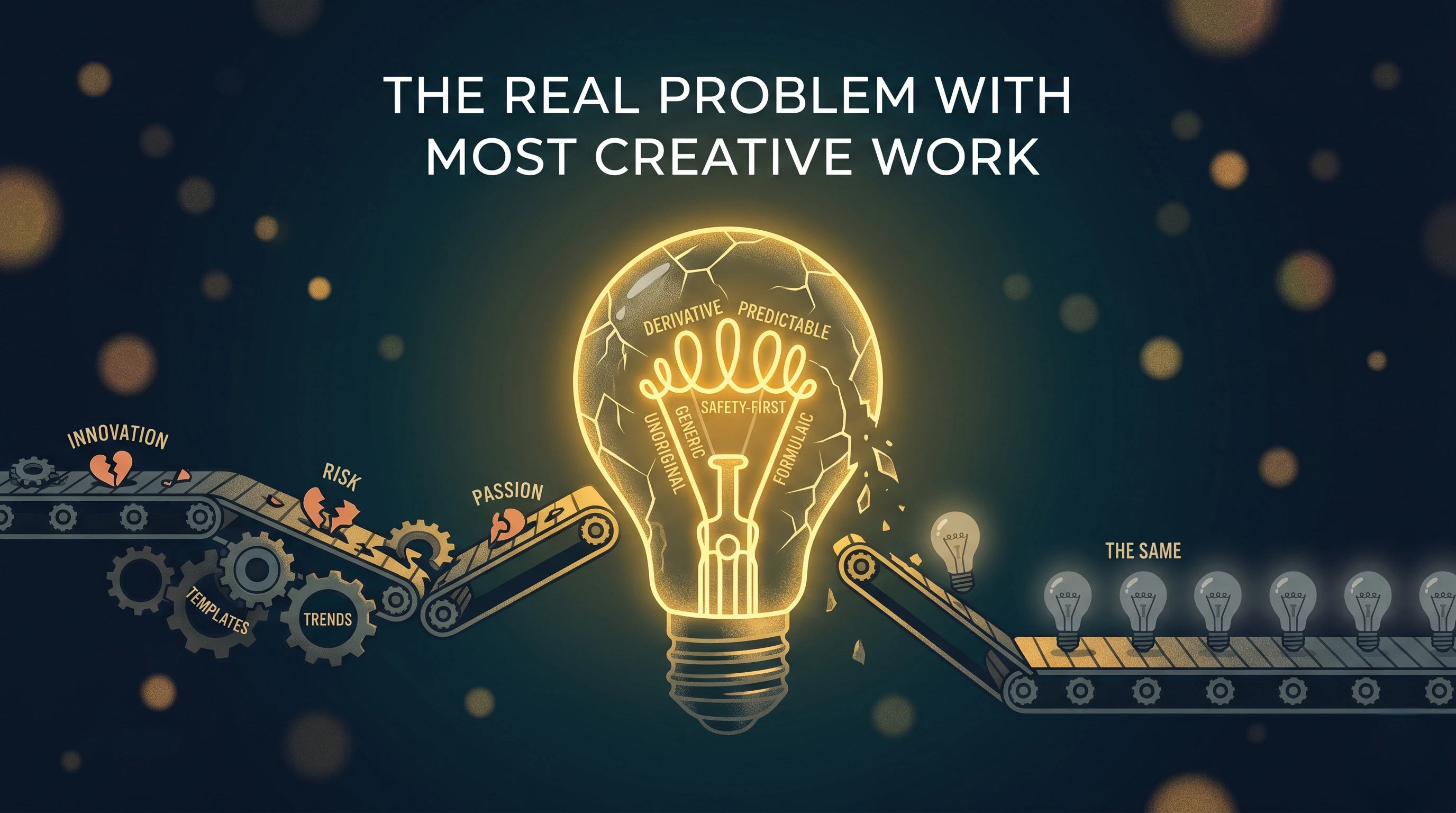
Most creative work gets evaluated the same way.
Someone looks at it. They form an impression. They say something based on that impression – whether it is “I love this” or “something feels off” or “make it pop.”
This kind of feedback is not useless. But it is incomplete. Because every person in the room is looking at the work through a different lens – and nobody has agreed on which lens actually matters.
The founder evaluates from the business angle: does this reflect our positioning? The designer evaluates from the craft angle: is the typography and layout strong? The marketing head evaluates from the campaign angle: will this drive leads? The client evaluates from personal taste: does this feel like something I’d be proud of?
Every perspective is legitimate. Every one is also incomplete.
Because the person who actually matters – the customer sitting somewhere, deciding in five seconds whether this brand is for them – was not represented in any of those reviews.
The brand does not live in the meeting room. It lives in the customer’s mind.
BrandLens360 is a four-angle evaluation framework that ensures the work is assessed from every perspective that actually counts – before a single revision is made based on someone’s instinct.
What BrandLens360 Is
Think of it as four different pairs of glasses.
Each pair shows you the same piece of work – but reveals something completely different. What looks perfect through one pair can have a serious flaw through another. And you would never know unless you wore all four.
Most creative professionals only ever wear one pair – usually the one they are most comfortable with. The designer wears the craft glasses. The marketer wears the campaign glasses. The founder wears the business glasses.
Nobody wears all four. And that is why so much work goes live with blind spots no one saw coming.
BrandLens360 is the discipline of wearing all four – deliberately, in sequence – before any creative decision is finalised.
The Four Lenses
Lens 1 – The Founder’s Lens
Does this serve the business goal?
Every brand has a strategic direction – a positioning, a promise, a place it is trying to reach. The Founder’s Lens checks whether a creative decision is aligned with that direction, or quietly drifting away from it.
This is the most commonly skipped lens. It is easier to approve something that looks good than to ask whether it is directionally correct.
But brands rarely fail because they look wrong. They fail because they drift – one approved decision at a time. Each individual piece looks fine. But across six months of approvals, the brand has slowly moved away from what it was trying to become.
Paper Boat is a clear example. Their entire positioning is built on nostalgia – the taste of Indian childhood, traditional flavours, emotional memory. Every creative decision passes through one filter: does this feel like something from a simpler time? When work drifts toward modern, trend-driven aesthetics – however polished – it breaks the system. The Founder’s Lens is what catches that drift.
The question to ask: Would the person who built this brand feel this represents what they set out to create?
Lens 2 – The Customer’s Lens
Does this create the right experience for the person it is designed for?
This is the perception lens. It does not ask what the brand intended – it asks what the customer will actually conclude in the first five seconds, without any help from the brand.
Most work is evaluated from the inside out. The team decides what they want to communicate, executes it, then asks whether it communicates what they intended. The Customer’s Lens forces the opposite – start from what the customer will actually experience, and work backward.
Groww built its entire product through this lens. Every screen, every piece of communication, every onboarding step was evaluated through one question: will someone who has never invested before feel capable and confident here – or overwhelmed and uncertain? That single question shaped everything – from the language used to explain financial terms, to what was shown first, to what was hidden until the user was ready. Millions of first-time investors trusted the product because it felt built for them.
The question to ask: What will the customer feel in the first five seconds – and is that what the brand needs them to feel?
Lens 3 – The Market Lens
Does this stand out in the environment it will actually live in?
This is the lens most teams forget. Work is evaluated in a meeting room – isolated, on a large screen, with full context and explanation. But it will live in the world surrounded by everything else competing for the same audience’s attention.
The Market Lens asks whether the work holds up in that context – not in isolation, but in the wild.
Dettol demonstrates this consistently. In a market where most hygiene brands use clinical, fear-based communication – lab coats, microscope imagery, germ-kill percentages – Dettol built a position around family protection and maternal confidence. Same category. Same functional claim. Completely different emotional territory. Their Market Lens told them that the category convention was fear, and the distinctive position was care. That one read has kept them differentiated in a commoditised category for decades.
The question to ask: If you removed the logo, would the audience know which brand this came from – and does it feel different from everything else in the same feed?
Lens 4 – The Creator’s Lens
Does the execution honour the strategy?
The Creator’s Lens comes last – and its position is intentional. Craft is evaluated after strategy is confirmed. Not because craft is less important, but because craft in service of the wrong strategy is waste.
The first three lenses ensure the direction is correct. The Creator’s Lens ensures the execution is worthy of that direction.
A premium brand with mediocre execution undermines every other lens. A strategically brilliant campaign with weak craft loses authority before it lands.
Tanishq’s jewellery campaigns show this at work. The emotional weight of their storytelling – women achieving milestones, families bridging generations – demands a specific quality of cinematography, colour grading, and editing pace. Cutting corners on execution would not just make the films look cheaper. It would make the emotion feel less earned. The craft is not decoration. It is the delivery mechanism for the strategy.
The question to ask: Does the execution quality – typography, pacing, colour, copy – match the brand’s positioning and the strategy behind the work?
How the Four Lenses Work Together
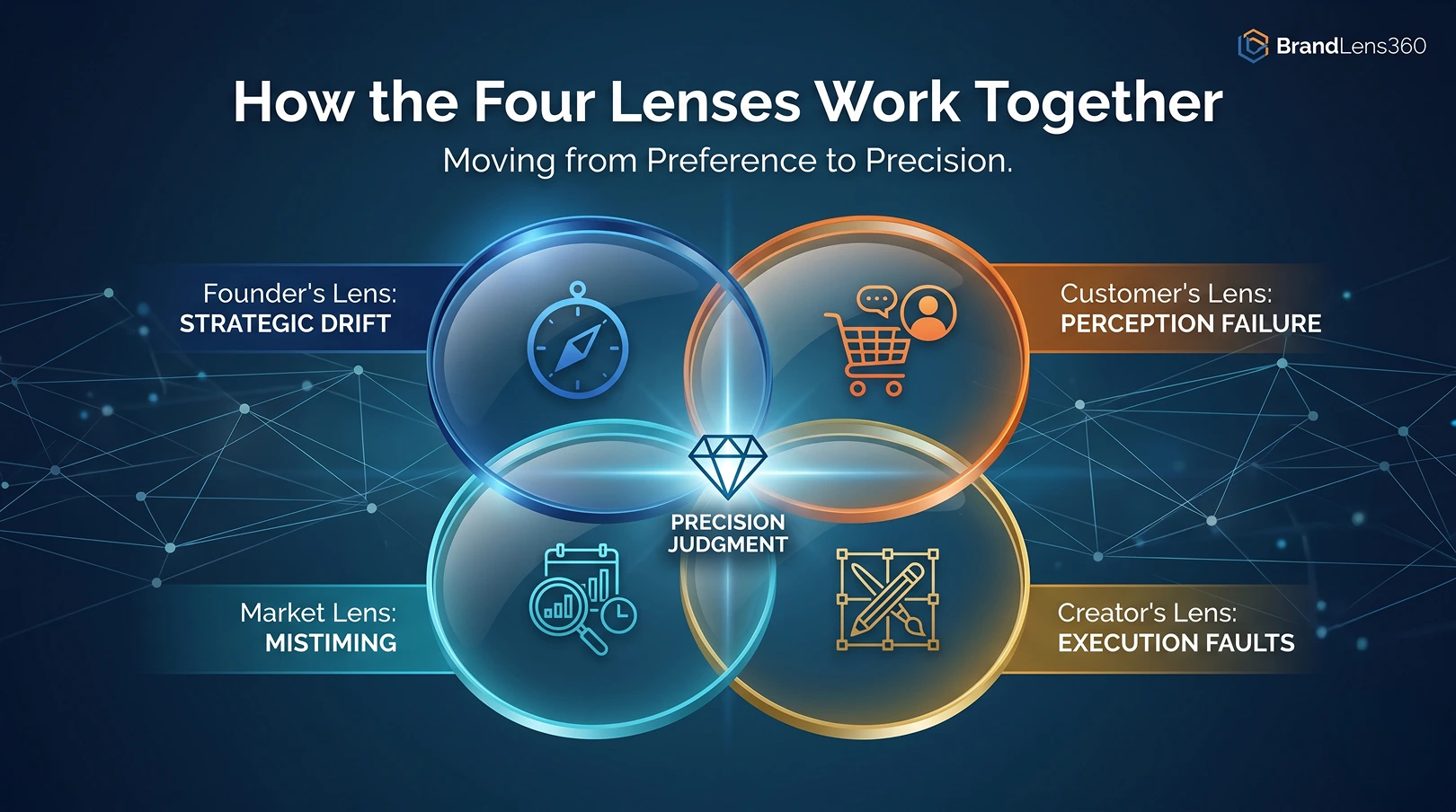
Each lens catches what the others cannot.
The Founder’s Lens catches strategic drift. The Customer’s Lens catches perception failure. The Market Lens catches invisibility and mistiming. The Creator’s Lens catches execution that undermines the strategy.
One lens alone produces bias. Four lenses together produce judgment.
This is the shift BrandLens360 makes possible: it moves a room from preference to precision. “I don’t like this” is a preference. It is not actionable. “This fails the Customer’s Lens because the call to action is buried and the audience will not know what to do next” is a diagnosis. It can be fixed.
Creative professionals stop feeling defensive when work is evaluated against a standard rather than a personal preference. A standard can be debated. A personal opinion cannot.
That shift alone makes creative reviews calmer, faster, and more productive. BrandLens360 does not remove creative judgment. It gives creative judgment a language.
A Simple Example
Take a course enrolment poster for a design institute.
The layout is modern. The colours are well-chosen. The typography is clean. It looks professional.
But run it through BrandLens360 and a different picture emerges.
Lens What It Reveals
Founder’s Lens
A prospective student cannot tell within five seconds why this institute is different from any other. No trust signal, no clarity on outcome.
Customer’s Lens
The poster leads with course duration and fees – but the institute’s positioning is about career transformation. The business intent is missing.
Market Lens
It looks identical to every other institute poster in the same category. Remove the logo and it could belong to anyone.
Creator’s Lens
The execution is competent, but the hierarchy is weak – the most important message is not the most visible element.
Without BrandLens360, you might have said: “It looks okay but something feels missing.” With it, you know exactly what is missing – and exactly what to fix.
How to Use It
BrandLens360 is not just for client reviews or team critiques. It is something every creative professional can run on their own work before it leaves their hands.
Before a piece of work goes anywhere – to a client, to a reviewer, to a team lead – ask four questions in sequence:
1. Founder’s Lens: Does this serve the brand’s strategic intent – or has it drifted?
2. Customer’s Lens: What will the audience actually feel and conclude in five seconds?
3. Market Lens: Does this stand out in the real environment it will live in?
4. Creator’s Lens: Does the execution quality honour the strategy?
If the work passes all four, you are not presenting it and hoping. You are presenting it and defending it – from every angle.
That is the difference between a creative professional who delivers and one who can be trusted.
Where BrandLens360 Sits in the System
BRIDGE asks: What should this piece of work achieve? BrandLens360 asks: does it actually achieve it?
One runs before execution. The other runs after. Together, they close the two gaps where most creative work fails – weak thinking before it begins, and weak evaluation before it goes live.
The 95% ask: “Do I like this?” The 5% ask: “Does this survive every lens it will be seen through?”
That single shift – from preference to structured evaluation – is what separates work that gets approved from work that actually works.
Explore the BRIDGE series:
● What Is BRIDGE? A Simple Framework to Make Better Creative Decisions
● Why Most Creative Work Fails – And How BRIDGE Helps You Solve the Right Problem
● From Executor to Strategic Thinker: How BRIDGE Helps Creative Professionals Stand Out
BrandLens360 is one of the core frameworks taught at Web D School, Chennai – part of a complete system alongside BRIDGE and PPR that trains creative professionals to think, evaluate, and communicate strategically.
Available on campus in Chennai and online across India.