
Why Most Creative Work Fails – And How BRIDGE Helps You Solve the Right Problem
Web D School | BRIDGE Framework
Here is something most creative professionals have experienced but rarely talk about.
You work hard on something. You put real thought into the design, the copy, the visuals. The client approves it. It goes live.
And then – nothing.
No enquiries. No conversions. No excitement. Just silence.
You go back and look at the work. It still looks good to you. So what went wrong?
This is one of the most frustrating experiences in creative work. And it happens far more often than people admit – at agencies, at in-house teams, at startups, at large companies.
The reason it keeps happening is almost never what people think it is.
The Diagnosis Problem
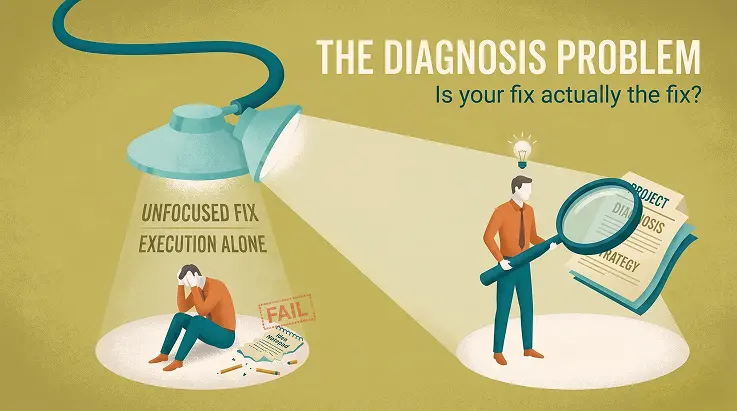
When creative work fails, the instinct is to fix the execution.
Change the design. Rewrite the copy. Try a different format. Run a new version of the ad. Add more features to the website.
Sometimes that works. Usually it does not – because the execution was not the problem. The problem was the diagnosis. Or more precisely, the absence of one.
Most creative work goes wrong not in the making, but in the thinking that happens – or does not happen – before the making begins.
The brief arrives. The software opens. The work starts. And somewhere in that gap between receiving the problem and starting to solve it, the most important questions never get asked.
● What is this work actually trying to change?
● What does the audience already believe – and what do we need them to believe instead?
● Are we solving the right problem, or just improving an approach that was already wrong?
When those questions are skipped, the result is work that is polished on the surface and misaligned underneath. It looks finished. It just does not work.
What Failure Actually Looks Like
Creative failure rarely announces itself dramatically.
It shows up quietly, in patterns that are easy to misread.
The logo that did not fix trust – A brand has been around for years. Sales have slowed. Customer feedback is lukewarm. Someone in a meeting says the brand looks dated – and suddenly a logo redesign becomes the solution. Months and money later, the new logo is live. Sales stay flat. Trust stays low. Because the logo was never the problem. The product experience, the communication, the after-sales behaviour – those were the problem. The logo just got blamed because it was visible.
The Instagram page that could not fix a weak offer – A business is not getting enough enquiries. Someone decides the social media presence needs to be stronger. Posts become more frequent. Reels get made. A designer is brought in. Engagement slowly improves. Enquiries do not. Because the real issue – that the offer was unclear, overpriced, or not compelling enough – was never examined. The Instagram page got better. The offer stayed weak.
The campaign that targeted the wrong person – A digital marketing team runs ads for three weeks. Click-through rate is decent. The landing page is professionally built. Conversions are terrible. The team iterates on the creative – new visuals, new headline, new call to action. Four versions later, conversions are still flat. Nobody asked whether the audience being targeted was even the right audience. The targeting was the problem from the beginning. The creative kept getting revised around a problem it could not solve.
The website that added complexity instead of clarity – A company’s enquiries are dropping. The team decides the website needs more information – more feature highlights, more use cases, more social proof. The website grows. Enquiries drop further. Because visitors were already confused. Adding more content to a confusing website does not create clarity. It creates more confusion.
In every one of these cases, the execution was not the failure. The diagnosis was.
The Improvement Trap
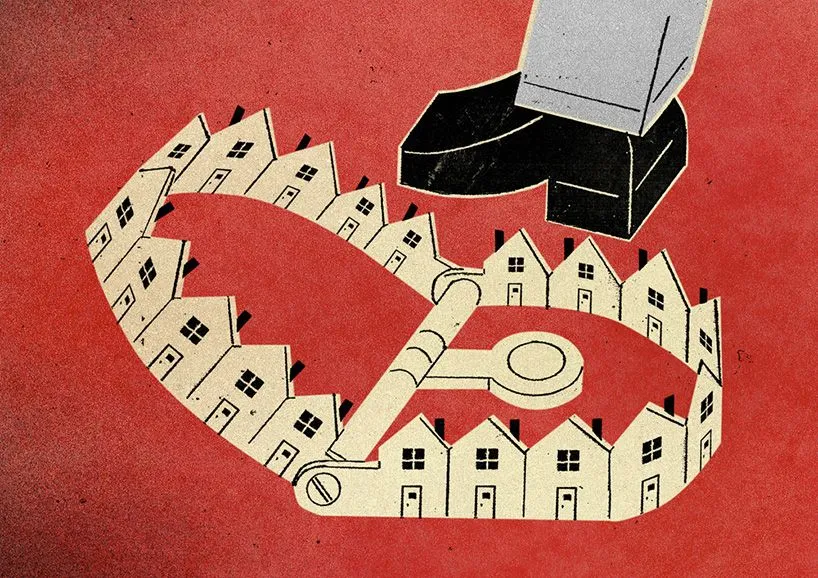
There is a specific pattern worth naming here, because it is very easy to fall into and very hard to see from the inside.
You look at what exists. You look at what is not working. And you improve it. Better photography. Better captions. Better targeting. Better design. Better copy. The work is clearly better than it was before. And it still does not move the needle. This is the Improvement Trap.
The work gets better – but it gets better within the same frame. Nobody stopped to ask whether the frame itself was the problem.
Improving the wrong thing faster is not progress. It is expensive motion in the wrong direction.
The 95% improve on what already exists. The 5% question whether what exists is even the right starting point.
That is not a small distinction. It is the difference between a creative professional who executes and one who thinks – and the gap between those two people, in terms of career, income, and impact, grows larger every year.
The Difference Between Symptoms and Problems
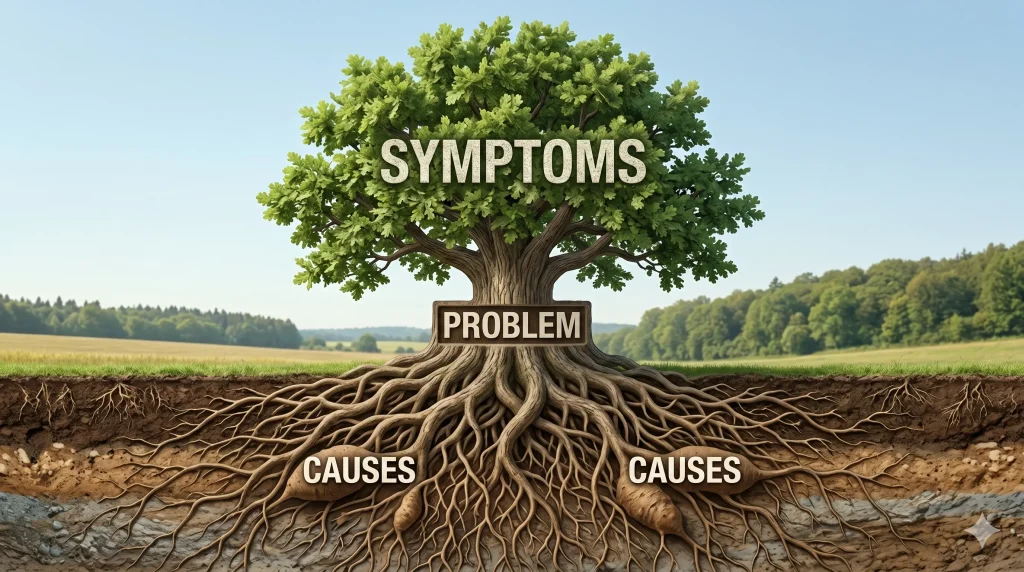
This is where creative professionals get trapped most often.
Clients explain symptoms. They rarely explain the real problem.
A client will say:
● “Our website is not converting.”
● “Our videos are not getting enough views.”
● “Our Instagram page feels boring.”
● “People are not clicking our ads.”
These are symptoms.
The real problem is almost always something different underneath.
A low-converting website may actually have a trust problem – people do not believe the offer enough to act on it. A boring Instagram page may be targeting the wrong audience entirely. Poor ad clicks may not mean the ad is weak; the offer itself may be weak. Low video views may not be an editing problem; the opening five seconds simply may not make people care.
Creative professionals who only solve symptoms stay executors.
Creative professionals who identify the real problem become Strategic Leaders.
That distinction – more than skill, more than tools, more than experience – is what determines the kind of career you build.
Why This Keeps Happening
If this pattern is so common, why does it keep repeating?
Because most creative education – and most creative work culture – is built around execution.
Schools teach tools. Internships teach workflows. Agencies teach turnaround time. The entire system rewards people for producing quickly, not for diagnosing carefully.
Nobody gets praised in a meeting for saying: “Before we start, I’d like to understand what the audience currently believes about this brand.”
They get praised for showing up with three concepts the next morning.
Execution feels safe. Diagnosis feels risky – because it makes you accountable for the outcome.
So professionals learn to move fast. They learn to execute confidently. They learn to iterate quickly when something does not work. What they do not learn is how to pause before the first move and ask whether they are solving the right problem.
That pause – that few minutes of structured thinking before anything is created – is where the best creative decisions are made.
What BRIDGE Does Differently
BRIDGE is not a creative process. It is a diagnostic system.
It helps creative professionals slow down the first five minutes to speed up the next five weeks.
It sits in that pause between receiving a brief and starting the work – and it fills that gap with six specific questions that need to be answered before execution begins.
Each question addresses a different dimension of the perception problem.
Is the audience going to understand this immediately, or will they be confused? Is this relevant to their life right now, or are we assuming it is? Does this brand make them feel something about themselves, or does it leave them indifferent? Is this piece of work placed correctly in their journey, or is it trying to do a job it was not designed for? Will they remember this tomorrow, or will it disappear into the noise? And is this brand growing with its audience, or slowly becoming background?
These are not creative questions. They are diagnostic ones. And they are the questions that separate work that looks good from work that actually achieves something.
When BRIDGE is run before execution starts, a specific thing happens: the problem becomes visible before the solution is built.
That means the solution can be built for the actual problem – not for a symptom of it.
Explore the BRIDGE series:
BRIDGE is one of the core frameworks taught at Web D School, Chennai. If you want to understand how it works in full, start with: What Is BRIDGE? A Simple Framework to Make Better Creative Decisions.
Available on campus in Chennai and online across India.