What Is the Expert Economy – And Why Every Creative Professional in India Needs to Understand It
Web D School | Expert Economy
In 2022, a designer who knew Figma, Photoshop, and basic UI principles could walk into an interview and walk out with a job offer.
Same designer. Same skills. Maybe even a little better.
In 2026, they’re still waiting for a callback.
Nothing went wrong with the person. Everything changed around them. And the biggest mistake any creative professional can make right now is preparing for a job market that no longer exists.
The Shift Nobody Announced
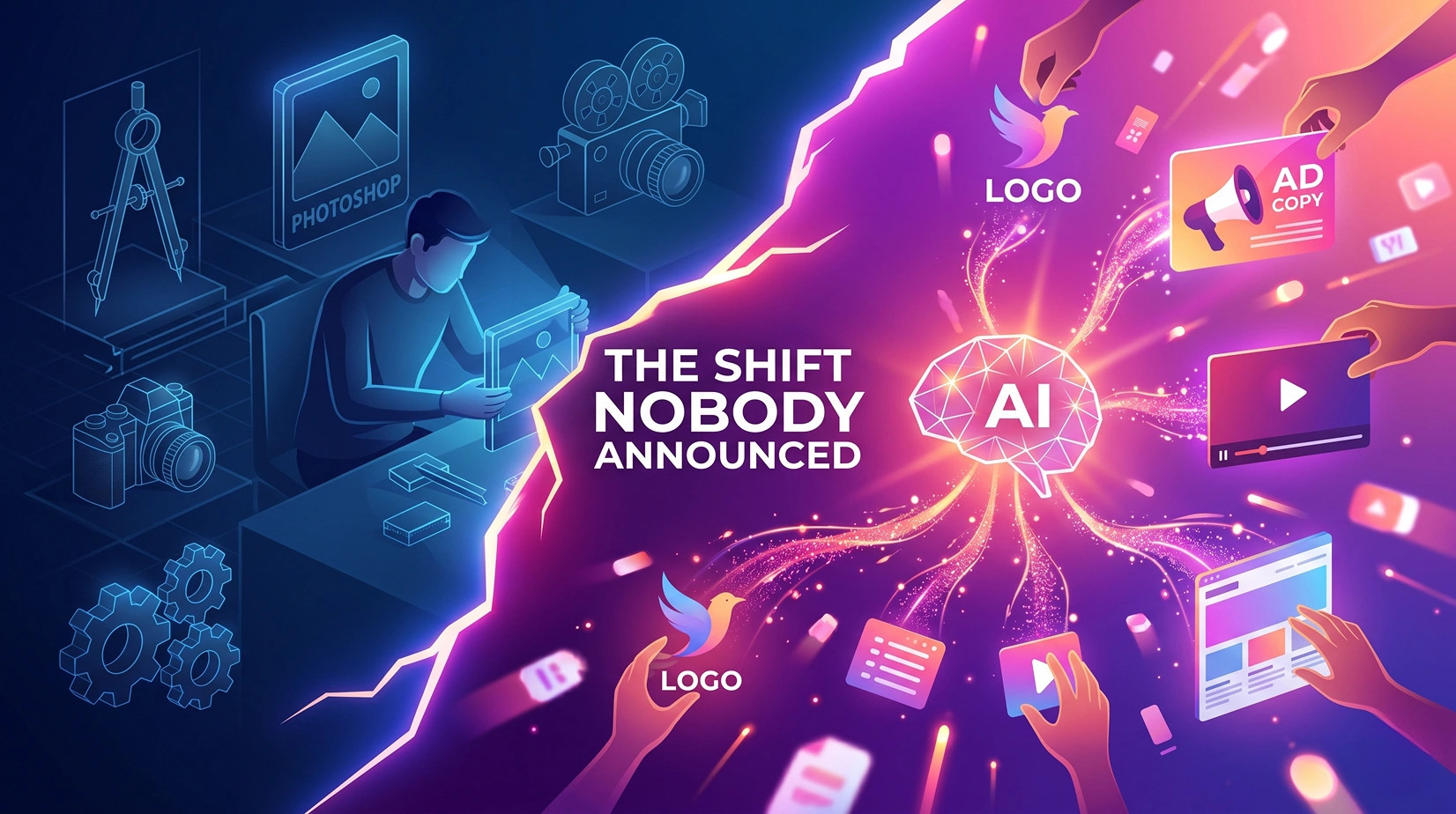
For a long time, the path was clear. Learn a skill, get a job, build a career. Knowing Photoshop was rare. Running Facebook Ads was a differentiator. Being able to build a responsive website put you ahead of most people in the room.
That era is over – and it ended faster than anyone expected.
Tools are now accessible to everyone. Tutorials are free. AI can generate a logo, write campaign copy, and edit a video in minutes. The barrier to entry for “doing creative work” has collapsed completely. Which means if you are competing on skill alone, you are competing with everyone. Including machines.
This is not a future problem. It is the current reality of every hiring conversation, every client pitch, and every freelance brief happening right now.
What the Expert Economy Actually Is
The Expert Economy is not a buzzword. It is a shift in what businesses actually pay for.
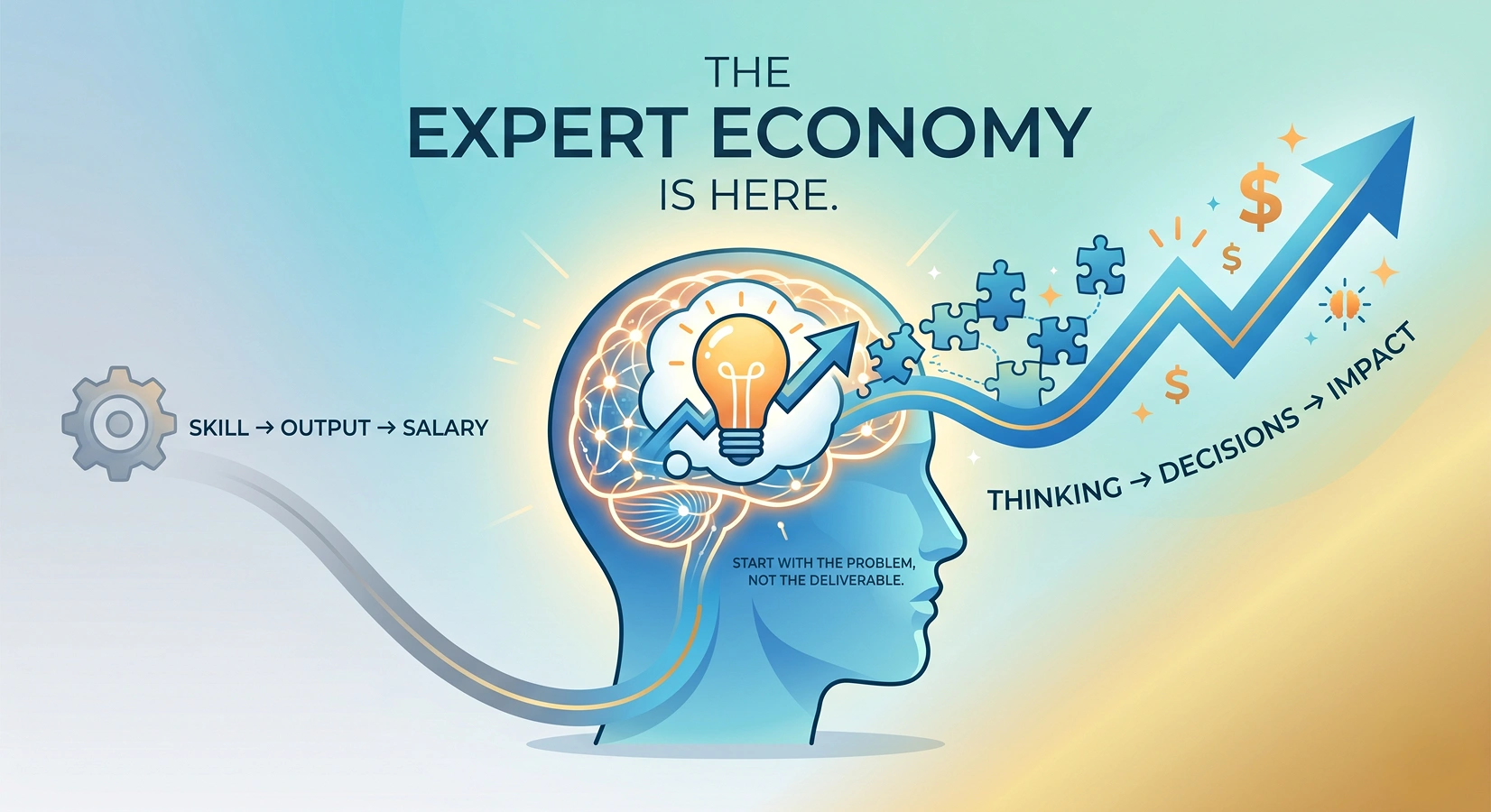
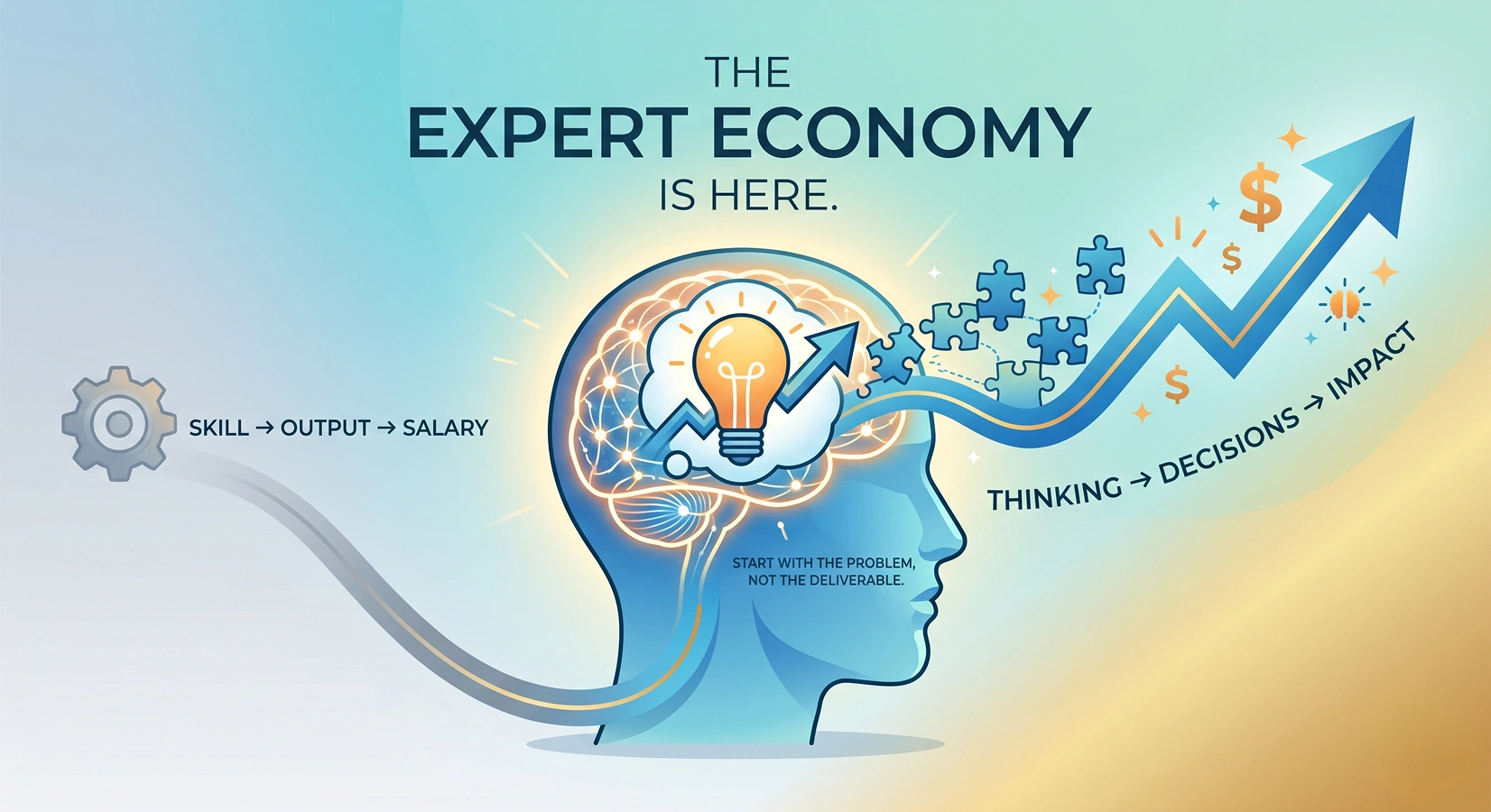
The old model was straightforward: Skill → Output → Salary. If you could produce reliably, you had value.
The new model works differently: Thinking → Decisions → Impact. Companies are no longer just hiring people who can execute. They are looking for people who can walk into a problem and figure out what to do. People who can look at a brand that is not working and say – with clarity and confidence – “Your problem is not design. It is positioning. Here is what needs to change.”
That person gets hired. That person gets retained. That person gets referred. The difference is not seniority. It is not years of experience. It is the direction of thinking. Execution starts with the deliverable. Expert Economy thinking starts with the problem.
What Businesses Are Actually Looking For
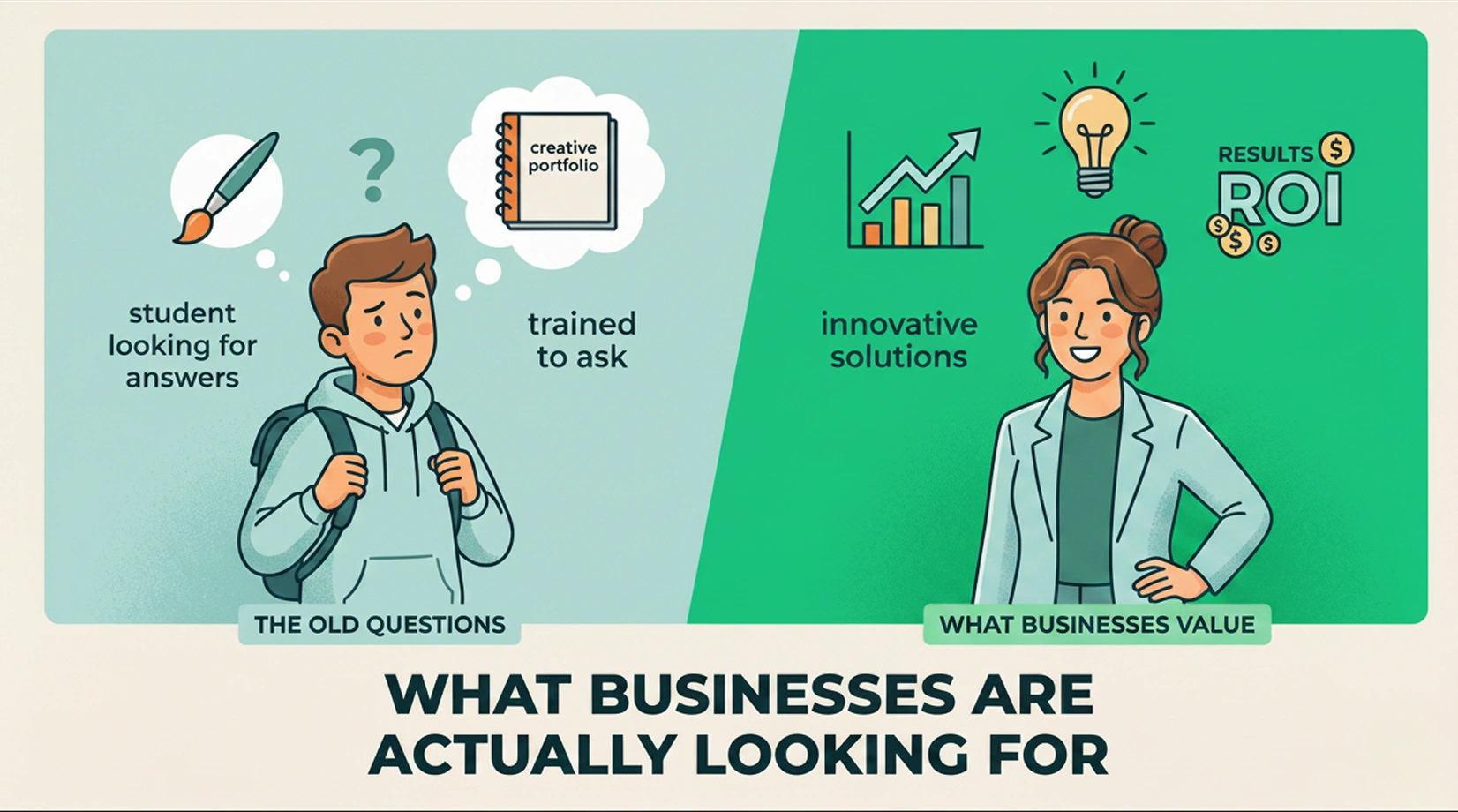
Here is what most creative students are trained to ask:
“How do I make a good poster?” “How do I design a clean UI?” “How do I run the ads?” Here is what businesses actually need someone to answer:
“Why isn’t our brand being understood?” “Why are users dropping off at this step?” “Why are these ads getting clicks but not conversions?”
Most courses teach deliverables. Very few teach problem-solving. And that gap – between what education produces and what the market needs – is where most creative careers stall.
The India Opportunity
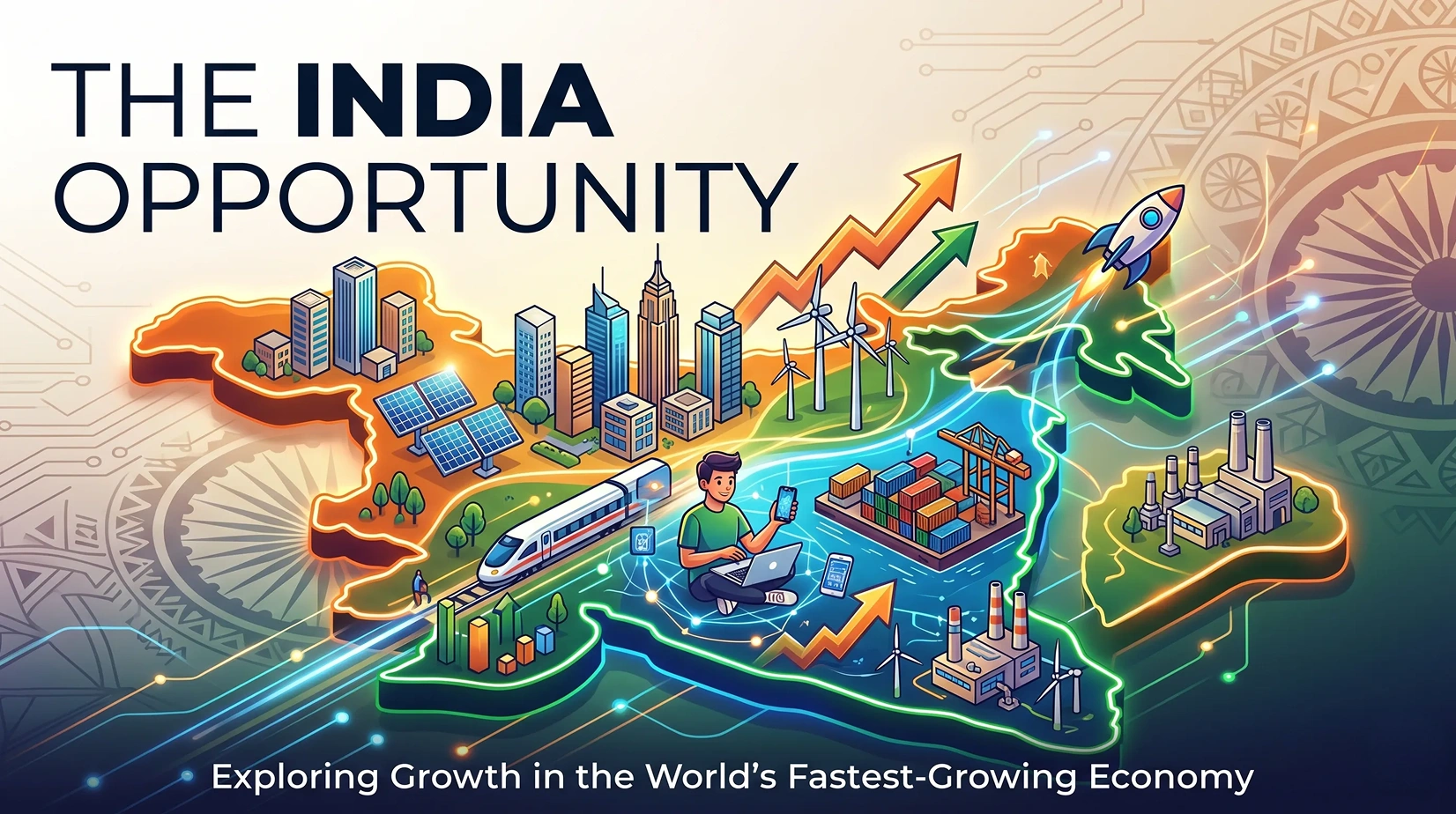
Before going further, it is worth saying clearly: the opportunity in India’s creative industry is real and it is large.
India’s creative sector is valued at approximately ₹3 lakh crore. Creative occupations pay nearly 88% more than non-creative ones and contribute close to 20% of the country’s Gross Value Added. The World Economic Forum’s Future of Jobs Report 2025 confirms that analytical thinking, creative problem-solving, and leadership are among the top skills Indian employers are actively seeking.
The demand is not shrinking. If anything, it is accelerating.
But what employers are willing to pay a premium for has changed completely. And the gap between professionals who understand this and those who don’t is widening fast.
India’s Structural Advantage
Here is something that rarely gets said directly in creative education: India gives you an edge that cannot be replicated by AI or outsourced to a foreign agency.
India is not a single market. It is hundreds of overlapping markets running simultaneously – different languages, different family structures, different relationships with money, technology, tradition, and aspiration. A campaign that works in Chennai fails in Chandigarh. A brand that resonates with a first-generation urban professional means nothing to their parents in the same household.
This complexity, which most Indian creative professionals see as a challenge, is actually the most rigorous strategic training ground on the planet.
If you understand why Zomato’s tone works – because it talks with urban Indians rather than at them – you have strategic instincts most professionals spend years trying to develop. If you understand why Fevicol’s advertising has outlasted every trend – because it is rooted in something emotionally true about Indian households – you understand brand identity at a level most textbooks cannot teach.
A creative professional who has spent their life inside this complexity and learned to read it – that person is not behind. They are ahead.
The question is whether they have a system to make that intuition consistent and communicable.
The AI Factor
The World Economic Forum’s report lists the skills surging in demand: analytical thinking, creative problem-solving, leadership, resilience. Notice what is not on that list – software proficiency, platform expertise, tool knowledge.
AI handles execution. Businesses now need people who handle judgment.
With 491 million active social media users and a creator economy growing at over 22% annually, India’s content volume is exploding. Every agency, every freelancer, every in-house team can now produce more, faster. In that environment, volume is not an advantage. The professionals who will command premium value are the ones who can do what AI cannot: understand context, navigate ambiguity, read human emotion, and make calls that require cultural intelligence.
AI produces outputs. Experts are paid for outcomes.
The question is not whether AI will affect your career. It already is. The question is which side of the shift you are on – the executor who gets replaced, or the thinker who becomes indispensable.
Two Paths
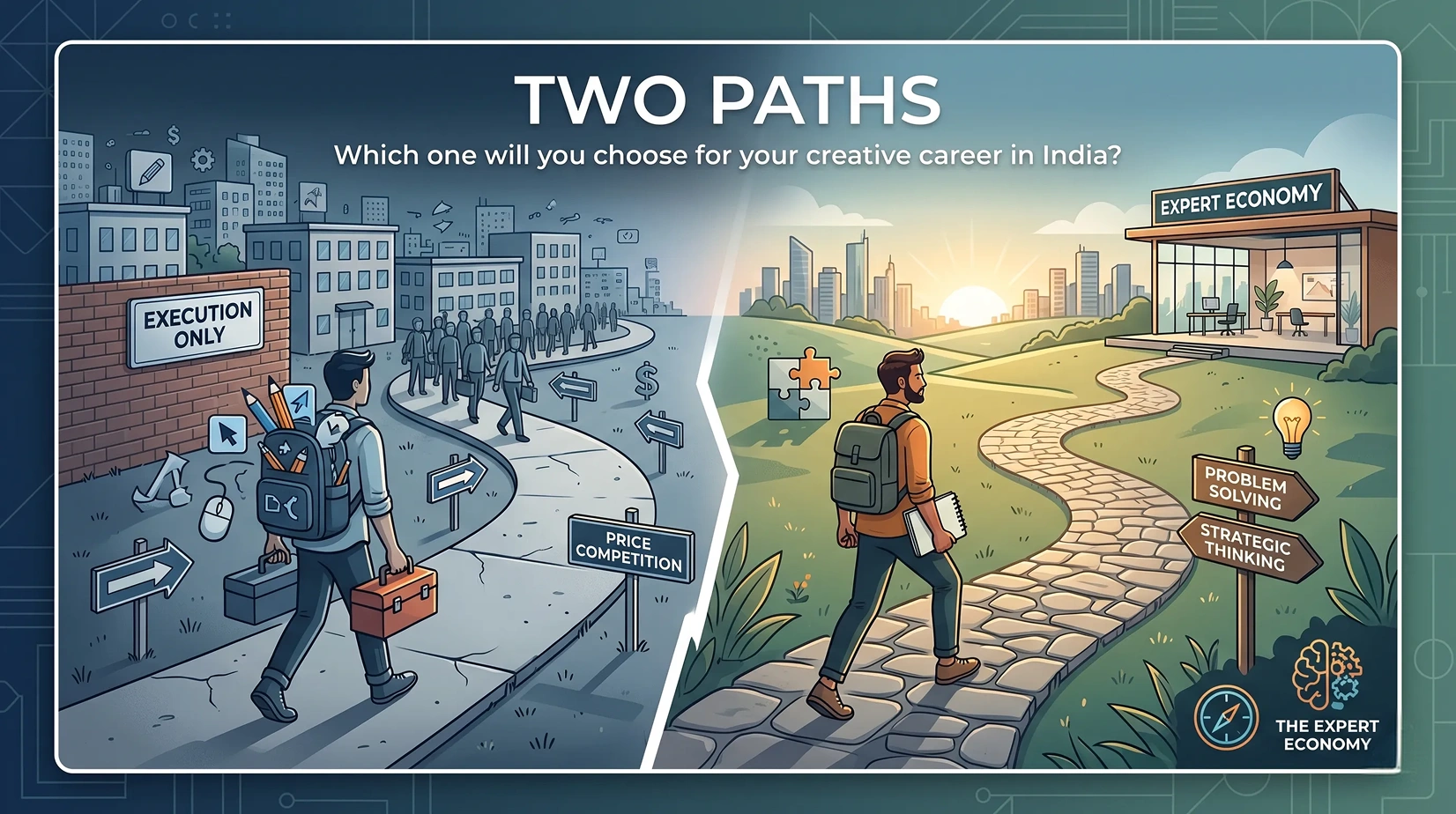
Two paths exist in the creative industry right now.
Path one: Learn tools. Execute briefs. Compete on price. Wonder why growth stops after two or three years.
Path two: Learn to think. Solve real problems. Become the person businesses depend on.
The Expert Economy rewards path two – not because it is harder, but because almost no one takes it. Most people stay in execution because that is where feedback is immediate and discomfort is low. Thinking is slower. It requires asking uncomfortable questions. It sometimes means telling a client their brief is solving the wrong problem.
But that is exactly what makes it valuable.
The creative professionals who will build lasting careers in India are not the fastest or the cheapest. They are the ones businesses trust to figure out what needs to be done — not just do what they are told.
That gap is wide open. And it belongs to whoever decides to step into it.
Where to Go From Here
Understanding the Expert Economy is the starting point. The next question is: what does Expert Economy thinking actually look like in practice – and how do you build it?
That is what the rest of this series covers.
● The 10 Things About the Expert Economy You Must Know as an Aspiring Creative Professional
● How Web D School Trains You to Think, Not Just Execute
Web D School is an Expert Economy institution. We train designers, marketers, and UX professionals to think strategically – through the BRIDGE Framework, live studio experience, and a curriculum built for the world as it is, not as it was.
Available on campus in Chennai and online across India.