
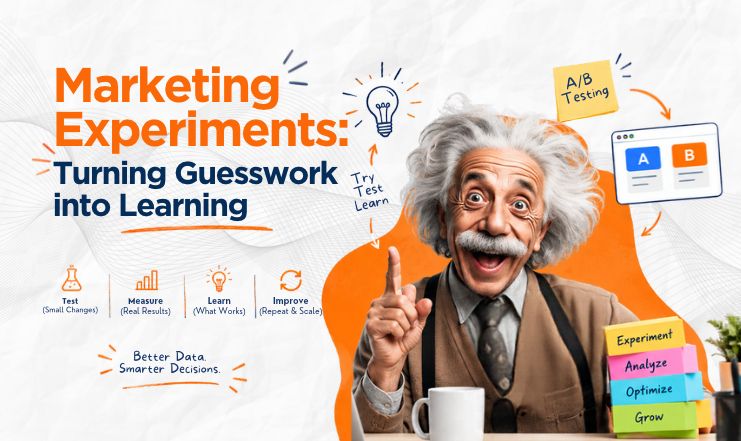
Marketing Experiments: Turning Guesswork into Learning
Web D School | Expert Economy
Marketing experiments help businesses move from assumptions to evidence. Instead of asking, “Which campaign looks better?”, marketers can ask a more valuable question: “What can we learn by changing one specific decision?”
In modern marketing, this matters more than ever. AI can generate dozens of headlines, creatives, videos, and campaign ideas in minutes. But producing more variations does not automatically create better marketing. Without a clear hypothesis and fair comparison, marketers can end up with more content but less understanding.
A good marketing experiment connects one deliberate change to one measurable outcome and turns the result into a useful business decision.
1. What Is a Marketing Experiment?
A marketing experiment is a structured test designed to understand whether a specific change affects a specific outcome.
A strong experiment usually contains five elements:
- Question: What are we trying to learn?
- Hypothesis: What do we expect to happen and why?
- Control: What is the existing or baseline version?
- Treatment: What specific change are we testing?
- Success metric: What result will determine whether the test worked?
For example:
Question: Will career-focused messaging increase course registrations?
Hypothesis: If a digital marketing course highlights portfolio-building and employability instead of only listing course features, qualified registrations will increase because prospective students care about career outcomes.
This is much more useful than simply saying, “Let’s try a new headline.”
2. Why Marketing Experiments Matter More in the AI Era
AI has made marketing execution faster.
A marketer can now generate:
- 20 headlines
- 10 ad concepts
- Multiple landing-page versions
- Different social media captions
- Several video scripts
But there is a major difference between creating variations and learning from variations.
If one advertisement changes its:
- headline,
- image,
- offer,
- CTA,
- audience, and
- landing page
At the same time, the marketer may see a performance change but cannot confidently explain what caused it.
AI makes execution cheaper. That makes disciplined experimentation more valuable, not less.
For marketers learning advanced campaign strategy through a Full Stack Digital Marketing Course, experimentation should be treated as a core skill alongside SEO, paid advertising, analytics, and content marketing.
3. Start With a Hypothesis, Not a Design
One of the biggest experimentation mistakes is starting with the asset instead of the question.
A weak approach is:
“Let’s create another Reel.”
A stronger approach is:
“Will explaining the product’s practical benefit in the first five seconds increase qualified enquiries?”
A useful hypothesis follows this structure:
If we change [variable] for [audience], then [outcome] will improve because [reason].
For example:
If we explain delivery area and ordering time in the first few seconds of a bakery Reel, qualified enquiries will increase because customers will immediately understand how to purchase.
Even if the test fails, the hypothesis creates a learning opportunity.
4. Test One Main Variable at a Time
Changing too many elements at once makes results difficult to interpret.
Imagine two landing pages:
Control
- “Learn Digital Marketing”
- Existing image
- Existing CTA
Treatment
- “Build Your First Digital Marketing Portfolio”
- New image
- New CTA
- New pricing
- New offer
If the treatment wins, what caused the improvement?
You don’t know.
A cleaner test changes one major variable while keeping other important conditions reasonably consistent.
This could mean testing:
- Value proposition A vs. value proposition B
- Long form vs. short form
- English vs. Tamil messaging
- Discount vs. free add-on
- Feature-focused vs. outcome-focused creative
The objective isn’t perfect laboratory conditions. It is to create a fair enough comparison to learn something useful.
5. Choose the Success Metric Before Running the Test
Never wait until the results arrive to decide what success means.
Use three levels of measurement:
Primary metric
The main metric that determines whether the experiment succeeded.
Examples:
- Qualified registrations
- Purchases
- Revenue
- Cost per qualified lead
- Attendance rate
Secondary metrics
Metrics that help explain what happened.
Examples:
- CTR
- Landing-page conversion rate
- Engagement
- Cost per click
- Form completion rate
Guardrail metrics
Metrics that make sure the improvement didn’t create another problem.
Examples:
- Lead quality
- Refund rate
- Complaints
- Unsubscribe rate
- Customer retention
- Sales conversion rate
For example, an advertisement may increase enquiries by 50%, but if most enquiries are irrelevant, the campaign hasn’t necessarily improved the business.
6. Test Decisions, Not Just Decorations
Some marketing tests are easy to run but have very little strategic value.
Changing:
- button colour,
- font size,
- icon style,
- image position
may occasionally improve performance, but bigger opportunities often come from testing customer motivations and value propositions.
Compare:
Message A:
“Learn 25 Digital Marketing Tools.”
Message B:
“Build Marketing Work You Can Show Employers.”
This is more meaningful than a simple design experiment because it tests what customers actually value.
For someone pursuing a Full Stack Digital Marketing Course, understanding this distinction is important: advanced marketing is not simply about improving individual campaign elements. It is about understanding customer behaviour and making better decisions from evidence.
7. Don’t Confuse Correlation With Causation
Suppose a business gets:
- 100 enquiries in June
- 140 enquiries in July
A new campaign launched in July.
It is tempting to say:
“The campaign generated 40 additional enquiries.”
But several other factors could have changed:
- Seasonal demand
- Festival promotions
- Competitor activity
- Pricing changes
- Market trends
- Website improvements
- Changes in sales follow-up
The campaign may have contributed, but the before-and-after comparison alone doesn’t prove it.
A stronger approach is to compare similar groups at the same time whenever practical.
This is the basic idea behind experimentation and incrementality.
8. Understand Incrementality
Optimization asks:
“Which version performed better?”
Incrementality asks:
“How many additional results happened because of the marketing?”
Imagine:
- 1,000 people see an advertisement
- 100 purchase
- A comparable control group of 1,000 people does not see the advertisement
- 80 purchase
The campaign should not automatically receive credit for all 100 purchases.
The incremental difference is approximately:
100 − 80 = 20 additional purchases
This is the counterfactual question:
What would have happened if we had done nothing?
That question becomes especially important when marketers evaluate paid advertising, retargeting, branded search, and other channels where some customers may have converted anyway.
9. Don’t Stop an Experiment Too Early
Small samples can produce misleading results.
For example:
- Version A: 4 visitors, 2 conversions = 50%
- Version B: 4 visitors, 3 conversions = 75%
Version B looks better, but one additional person completely changes the result.
A larger sample provides stronger evidence, although large sample size alone does not guarantee business importance.
Before starting a test, establish:
- Minimum test period
- Expected sample size
- Primary metric
- Stopping rule
- Decision criteria
Also distinguish between statistical significance and business significance.
A conversion rate increasing from 5.0% to 5.1% might be statistically reliable with enough traffic but still have little commercial value.
10. Follow the Result Down the Funnel
Never judge an experiment only by the metric closest to the change.
Consider a lead form experiment:
Long form
- 100 leads
- 15 customers
Short form
- 140 leads
- 15 customers
The short form produced 40% more leads, but it didn’t produce more customers.
That means the experiment improved the immediate conversion metric without improving the final business outcome.
The same principle applies to:
- Clicks → qualified leads
- Leads → sales
- Sales → retained customers
- Opens → purchases
- Registrations → attendance
More conversions are not automatically better conversions.
This is why marketers studying advanced digital marketing should connect experimentation with analytics, attribution, and business economics rather than evaluating every test in isolation.
11. Use Customer Research to Understand Why
Numbers tell you what changed. They don’t always tell you why.
Suppose a landing-page experiment shows that career-focused messaging performs better than feature-focused messaging.
The next question should be:
“Why did customers respond to it?”
Useful sources of insight include:
- Customer interviews
- Sales calls
- Search queries
- Reviews
- Support conversations
- Survey responses
- Comments and messages
A powerful learning loop is:
Listen → Hypothesise → Test → Observe → Learn → Test Again
This prevents experimentation from becoming a collection of disconnected A/B tests.
12. Small Businesses Can Experiment Too
Experimentation isn’t only for large companies with data-science teams.
A local restaurant can test:
Offer A: 10% discount
Offer B: Free dessert
A local bakery can test:
Message A: “Fresh Homemade Cakes”
Message B: “Order Your Celebration Cake 24 Hours in Advance”
A digital marketing institute can test:
Message A: “Learn Digital Marketing”
Message B: “Build a Portfolio for Your Marketing Career”
The key is not complexity.
The key is having:
A meaningful question + a fair comparison + a measurable outcome.
This mindset is especially useful for marketers building practical skills through a Full Stack Digital Marketing Course, where experimentation connects theory with real campaign decision.
13. Document What You Learn
A business can run 50 experiments and still learn very little if nobody records the findings.
For every experiment, document:
| Element | What to Record |
| Problem | What are we trying to solve? |
| Hypothesis | What do we believe will happen? |
| Control | What is the baseline? |
| Treatment | What changed? |
| Primary Metric | What determines success? |
| Guardrails | What could indicate unintended damage? |
| Result | What happened? |
| Learning | What did we actually discover? |
| Next Test | What should we investigate next? |
The most valuable field is often Learning.
Don’t just record:
“Version B won.”
Record:
“Outcome-focused messaging generated fewer overall leads but a higher proportion of qualified prospects, suggesting career outcomes matter more than tool lists for this audience.”
That becomes reusable knowledge.
14. Avoid These Common Experimentation Mistakes
Here are the most common mistakes marketers should avoid:
- Testing without a hypothesis — numbers are collected without a clear learning objective.
- Changing too many variables — you cannot identify what caused the result.
- Stopping too early — random fluctuations can look like a winning version.
- Using tiny samples — one or two customers can distort the result.
- Choosing the metric afterward — this encourages confirmation bias.
- Optimising vanity metrics — more clicks don’t necessarily mean more revenue.
- Ignoring guardrails — short-term gains can damage trust or lead quality.
- Ignoring downstream results — more leads may produce no additional customers.
- Ignoring external factors — seasonality or competitor activity can influence results.
- Testing low-impact details first — marketers can spend months testing button colours while their value proposition remains unclear.
A useful prioritisation question is:
“If our assumption is wrong, how expensive could that mistake become?”
Test high-impact assumptions first.
15. A Simple Marketing Experiment Framework
You can use this five-step framework for almost any marketing experiment:
Step 1: Identify the uncertainty
What don’t we know?
Example: We don’t know whether customers care more about career outcomes or course features.
Step 2: Write the hypothesis
What do we believe and why?
Example: Career-focused messaging will increase qualified registrations because learners want to understand what the course can help them achieve.
Step 3: Create control and treatment
Control: Feature-focused message
Treatment: Career-focused message
Step 4: Define success
Primary: Qualified registrations
Secondary: Landing-page conversion rate
Guardrail: Lead quality and sales conversion
Step 5: Capture the learning
Don’t simply choose a winner.
Ask:
What did this experiment teach us about our audience?
That answer should influence the next experiment.
FAQ: Marketing Experiments
1. What is a marketing experiment?
A marketing experiment is a structured test where a marketer changes a specific variable, compares the result against a control or baseline, and uses predefined metrics to learn whether the change influenced performance.
2. What is the difference between A/B testing and marketing experimentation?
A/B testing compares two or more versions of something, while marketing experimentation is the broader process of identifying uncertainty, forming a hypothesis, designing a fair test, measuring outcomes, and applying the learning. A/B testing can be one method within that process.
3. What should marketers test first?
Marketers should usually prioritise high-impact assumptions such as value proposition, offer, audience, positioning, messaging, funnel structure, and customer motivation before spending significant time on minor design elements.
4. How long should a marketing experiment run?
There is no universal number of days. The experiment should run long enough to collect a meaningful sample while accounting for normal business cycles. Define the minimum test period and stopping rules before launching rather than stopping when one version happens to lead.
5. What is a control group in marketing?
A control group is the baseline group that does not receive the tested change. Comparing it with the treatment group helps marketers estimate whether the change contributed to the observed difference.
6. What is incrementality in marketing?
Incrementality measures the additional outcomes caused by marketing that would not have occurred without it. It attempts to answer the counterfactual question: what would have happened if the marketing activity had not taken place?
7. Can small businesses run marketing experiments?
Yes. Small businesses can run simple experiments by testing meaningful differences in offers, messaging, audiences, content formats, or customer experiences. They don’t necessarily need sophisticated analytics systems to start learning systematically.
8. What is the biggest mistake in marketing experimentation?
The biggest mistake is running tests without knowing what the business is trying to learn. A test can produce statistically interesting numbers while providing little useful information if there is no clear hypothesis, success metric, or decision attached to the result.
The Main Lesson
Marketing data tells us what happened.
Attribution estimates which touchpoints may have contributed.
ROAS, CAC, and LTV help determine whether the economics are healthy.
Experimentation asks a different question:
What actually changed because we made this decision?
The goal isn’t to find a winning headline, creative, landing page, or campaign every time.
The goal is to reduce uncertainty.
Start with a real question. Build a clear hypothesis. Change one important variable. Create a reasonable comparison. Define success before seeing the result. Track downstream outcomes and guardrails. Then document what you learned and use it to create the next question.
AI can generate almost unlimited marketing variations.
But variation is not learning.
The marketers who create the greatest advantage will be those who can turn all those possibilities into disciplined experiments and build knowledge from every result — including the tests that fail.
Good marketers optimise campaigns. Great marketers build systems that keep learning.