
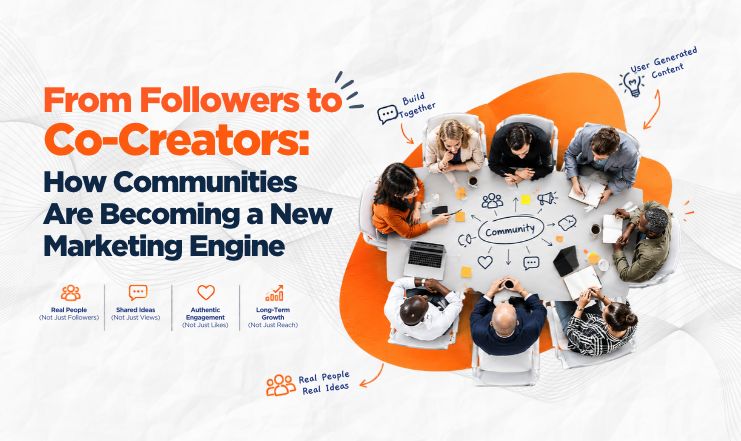
From Followers to Co-Creators: How Communities Are Becoming a New Marketing Engine
Web D School | Expert Economy
For years, brands measured digital marketing success through followers, likes, reach, and impressions. But having a large audience does not necessarily mean having influence.
Today, an important shift is taking place: customers are becoming participants rather than passive followers. They ask questions, share experiences, create content, recommend products, give feedback, and sometimes even influence what a brand builds next.
This is where community-led marketing becomes powerful. Instead of simply asking, “How can we reach more people?”, brands are beginning to ask, “How can we help people create value together?”
Here are the key ways communities are becoming a new marketing engine.
1. Understand the Difference Between an Audience and a Community
Audience and a Community
An audience consumes content. A Audience and a Community community participates in conversations and creates value.
Traditional marketing often follows this model:
Brand creates → Customer watches → Customer buys
Community-led marketing changes it to:
Brand creates a space → Members participate → Members contribute → Community influences the brand
For example, a brand’s Instagram followers may simply watch its Reels. A community, however, may discuss those Reels, answer questions, share their own experiences, and suggest future content.
The key difference is participation.
2. Don’t Confuse a Group With a Community
Creating a WhatsApp or group does not automatically create a community.
A genuine community needs:
- A clear purpose
- A reason for members to return
- Interaction between members
- Shared interests or goals
- Opportunities to contribute
- Recognition for useful contributions
A simple test is:
What can members do together here that they cannot do as easily elsewhere?
If the answer is only “receive our updates,” you probably have a broadcast channel rather than a community.
3. Build Communities Around a Shared Purpose
People rarely feel connected simply because they purchased the same product.
A stronger community identity is built around a shared problem, ambition, profession, interest, or journey.
For example, instead of:
“People who bought our digital marketing course”
a stronger identity could be:
“Young marketers building practical skills for an AI-powered industry.”
This creates a reason for members to learn, communicate, collaborate, and return.
For an educational brand, a community could revolve around learning, practical projects, networking, portfolio development, and career growth. Someone researching a Full Stack Digital Marketing Course could therefore gain more value when the learning experience extends beyond lessons into peer discussions, project feedback, and collaboration.
4. Give Members a Journey From Followers to Co-Creators
Not every community member becomes active immediately. A useful member journey is:
Join → Learn → Contribute → Create → Guide
Join
The person discovers the community and understands why it is useful.
Learn
They consume resources, ask questions, and observe discussions.
Contribute
They begin answering questions, sharing experiences, or providing feedback.
Create
They produce tutorials, templates, case studies, videos, or community resources.
Guide
Experienced members help newcomers, answer recurring questions, and become informal mentors.
This progression turns a passive follower into someone who actively contributes to the community.
5. Make Community More Valuable Than Promotion
One of the fastest ways to destroy a community is to turn it into a permanent sales channel.
A healthy community should provide value through:
- Education
- Peer support
- Discussions
- Networking
- Recognition
- Challenges
- Feedback
- Co-created resources
Promotional messages can exist, but they should not dominate the experience.
For example, a community built around a Full Stack Digital Marketing Course could discuss SEO experiments, social media strategies, AI tools, campaign results, and portfolio projects instead of constantly promoting the course itself.
Community is not a captive audience.
6. Use the Co-Creation Loop
A powerful community doesn’t simply collect feedback. It demonstrates that feedback can create change.
A simple co-creation process is:
Ask → Collect → Group → Prioritise → Build → Show → Invite → Recognise
For example, suppose students repeatedly say they struggle with building portfolios.
The brand can:
- Ask members about their biggest portfolio challenges.
- Collect and group the responses.
- Let members vote on the most important problem.
- Create a portfolio workshop.
- Ask members to test it.
- Improve the workshop using their feedback.
- Show members what changed.
- Recognise contributors.
This creates a feedback loop where members can see that their participation matters.
7. Let the Community Influence the Product
Co-creation becomes meaningful when member feedback influences something real.
Brands can invite communities to help shape:
- New products
- Features
- Workshops
- Courses
- Content topics
- Events
- Templates
- Campaign concepts
- Customer experiences
For instance, students taking a Full Stack Digital Marketing Course could vote on whether the next practical session should focus on SEO, paid advertising, AI search visibility, or social media campaigns.
The important part is not simply asking for opinions. The brand needs to show what happened because members participated.
8. Learn From Other Types of Communities
Brands can borrow useful principles from successful communities without copying them completely.
- Classrooms: peer learning and progress milestones
- Gaming: challenges, levels, and achievement
- Sports teams: coaching and team identity
- Open-source communities: contribution and recognition
- Fan communities: shared language and member-created content
The lesson is simple: identify the behaviour that makes another community successful and adapt the underlying principle to your audience.
9. Choose the Platform Based on Behaviour
The platform should support the behaviour you want rather than determine your strategy.
| Platform | Best suited for |
| Local groups and course cohorts | |
| Discord | Learning and technical communities |
| Telegram | Large or regional communities |
| Creator-led and visual communities | |
| Peer discussions and advice | |
| Structured professional communication |
Before creating a new community, ask whether your audience is already discussing the topic somewhere else.
Sometimes the best strategy is not creating another platform. It is joining and supporting an existing conversation.
10. Start Small and Measure Community Health
A community does not need thousands of members to be successful.
A small group of 300 active members can create more value than 10,000 passive followers.
Track metrics such as:
- Activation: Did new members take a first action?
- Participation: Are members contributing?
- Member-to-member replies: Are people helping one another?
- Retention: Do members return?
- Response time: Are questions receiving answers?
- Co-creation: Are member ideas being implemented?
- Business impact: Are referrals, enquiries, retention, or support efficiency improving?
Member count is useful, but it should never be the only measurement.
11. Recognise Valuable Contributions
Recognition encourages useful participation.
It could include:
- Member spotlights
- Project showcases
- Community mentor badges
- Featured contributions
- Case studies
- Expert sessions
- Public appreciation
However, recognition should reward value rather than volume.
The person who posts 50 messages is not necessarily more valuable than someone who gives one detailed answer that solves another member’s problem.
12. Remember That Community Needs Moderation
Community-led does not mean completely uncontrolled.
Clear rules help protect the quality of the environment.
For example:
- Respect different experience levels.
- Critique ideas rather than people.
- Avoid spam.
- Don’t share misleading information.
- Respect members’ privacy.
- Get permission before using someone’s work.
AI can help summarise discussions, categorise questions, and identify potential moderation issues. However, sensitive decisions still require human judgment.
Community participation should influence the brand, but it does not mean members make every business decision.
13. Avoid These Common Community Marketing Mistakes
The biggest mistakes are often simple.
Mistake 1: Creating a community without a purpose
Mistake 2: Making everything promotional
People will leave if every interaction becomes a sales pitch.
Mistake 3: Asking generic questions
Instead of “What do you think?”, ask a specific question members can answer from experience.
Mistake 4: Ignoring member feedback
If people repeatedly give ideas and never see results, they eventually stop contributing.
Mistake 5: Measuring only member count
Large numbers do not automatically indicate a healthy community.
Mistake 6: Over-moderating
Removing every disagreement can destroy authenticity and trust.
Mistake 7: Under-moderating
Spam, misinformation, and harassment can damage a community quickly.
14. Understand Why Communities Matter in an AI-Saturated World
AI has made it easier to create blogs, videos, advertisements, social posts, emails, and other marketing assets at scale.
As content becomes easier to produce, genuine human participation becomes more valuable.
AI can generate information. It cannot automatically create:
- Belonging
- Trust
- Shared experience
- Peer relationships
- Community identity
- Genuine advocacy
This creates an important marketing distinction:
Content can be generated. Community has to be earned.
Brands that use AI to produce more content while simultaneously creating meaningful spaces for customers to interact can build a stronger long-term relationship with their audience.
15. Ask the Final Community Test
Before launching a community, ask two questions:
1. What valuable thing can members do together here that they cannot do as easily elsewhere?
2. Would members still return if there were no discounts or promotions?
If the answers are strong, there may be a genuine community opportunity.
If not, the brand may simply be creating another marketing channel and calling it a community.
Why Communities Are Becoming a New Marketing Engine
The biggest change is the movement from reach to relationship.
Traditional marketing asks:
“How many people can we reach?”
Community-led marketing asks:
“What can these people create, learn, solve, or build together?”
A follower can become a learner.
A learner can become a contributor.
A contributor can become a creator.
A creator can become a guide.
And a guide can become one of the strongest advocates for the brand.
That is why the future of community marketing is not simply about gaining more members. It is about giving members a meaningful role.
The strongest brands will not treat customers as the final destination of marketing. They will increasingly treat customers as participants in the process of creating knowledge, products, experiences, and ideas.
Frequently Asked Questions
1.What is community-led marketing?
Community-led marketing is a strategy where customers, fans, learners, or users actively contribute to a brand through discussions, feedback, user-generated content, referrals, peer support, and co-creation.
2.What is the difference between an audience and a community?
An audience mainly consumes content from a brand, while a community participates in conversations and creates value with other members. Participation Builds Brands.
3.Why are communities important for marketing?
Communities can strengthen trust, customer retention, advocacy, referrals, customer insight, and user-generated content. They can also help brands understand customer problems more deeply.
4.How do you turn followers into community members?
Give followers a clear reason to participate. Create useful discussions, encourage peer interaction, recognise contributions, ask specific questions, and demonstrate that member feedback leads to visible action.
5.What makes a successful online community?
A successful online community generally has a clear purpose, active participation, useful member-to-member interaction, good moderation, meaningful recognition, and evidence that member contributions matter.
6.How can AI help community marketing?
AI can help categorise questions, summarise discussions, identify recurring topics, recommend content ideas, and support moderation. However, human judgment remains important for trust, relationships, and sensitive community decisions.
7.What should community managers measure?
Useful metrics include activation rate, participation, member-to-member replies, retention, response time, questions answered, ideas implemented, and relevant business outcomes. Member count alone is not enough.
8.Is a WhatsApp group a community?
Not necessarily. A WhatsApp group becomes a community when members have a shared purpose and actively interact, contribute, support one another, and create value. If members only receive promotional messages, it is closer to a broadcast channel.
9.What is co-creation in marketing?
Co-creation happens when customers actively help a brand develop products, services, content, experiences, campaigns, or ideas. Their participation influences the final outcome rather than simply providing passive feedback.
10.What is the main lesson of community-led marketing?
The main lesson is simple: stop treating customers only as an audience and give them a meaningful role in the brand’s journey. The strongest communities turn followers into participants, contributors, creators, and advocates.