

Why 5% of People Grow Fast in Their Careers (And 95% Don’t)
Take any company. Any office. Any team.
A hundred people join on the same day. Same role. Same salary. Same first-day nervousness.
Twenty years later – five of them are running departments, leading teams, or building their own
businesses. The other ninety-five? Still working. Still trying. Still waiting for their turn.
And the sad part is – the ninety-five are not lazy people. Most of them are actually the
hardworking ones.
So what went wrong?
It’s Not About Talent. It’s About How You Think.

Most people believe career growth comes from learning more skills, working harder, and putting
in more hours. That’s what we’re taught from day one.
But after running a branding company, teaching hundreds of students, and watching careers
closely for years – the pattern becomes very clear.
The gap between the 5% and the 95% has nothing to do with talent. Nothing to do with luck or
connections either – though people love to blame those.
It has everything to do with how they think.
Not surface thinking. Strategic thinking.
Surface thinking says: “Give me the task. I’ll do it well.”
Strategic thinking says: “Wait – why are we doing this task at all? What problem are we
actually solving?”
That one shift. That one question. Changes everything.
You see this pattern everywhere. A hundred students join a cricket academy – five go on to
play for their state or country. A hundred small businesses start in the same city, same year –
five actually grow, the rest just survive. Same city. Same resources. Same opportunities.
Different thinking.
How AI Has Changed Career Growth for Everyone

This isn’t just a career problem. It affects students, professionals, founders, people in tech, and
creators equally.
For a long time, having a skill was enough. Knowing Photoshop. Knowing how to code. Knowing
how to run ads. Knowing how to edit video. These things had value because not everyone could
do them.
That’s not the case anymore.
AI tools today can design, write, code, edit, and strategise – in minutes. The bar for “decent
work” in any field has dropped to almost zero.
So if your answer to “why should someone hire you or pay you” is “I do good work” – that’s not
enough anymore. Not because you’re not good. But because a thousand other people – and
now AI – can also do good work.
The ones building real careers and real businesses today are not the fastest executors. They
are the clearest thinkers.
The Career Ceiling Nobody Talks About
Here’s something most people feel but never say out loud.
Somewhere around year three or four of your career – things slow down. Your work is good.
Clients are happy. Portfolio looks solid. But the promotions aren’t coming. Your fees are stuck.
The big conversations – the strategy meetings, the planning sessions – nobody’s calling you
for those.
You’ve become “the person who does good work.”
That sounds like a compliment. Until you realise it’s a ceiling.
Because you’re being paid for what you do. Not for how you think. And what you do has a
market rate. How you think has no ceiling.
Two Professionals. Same City. Different Outcomes
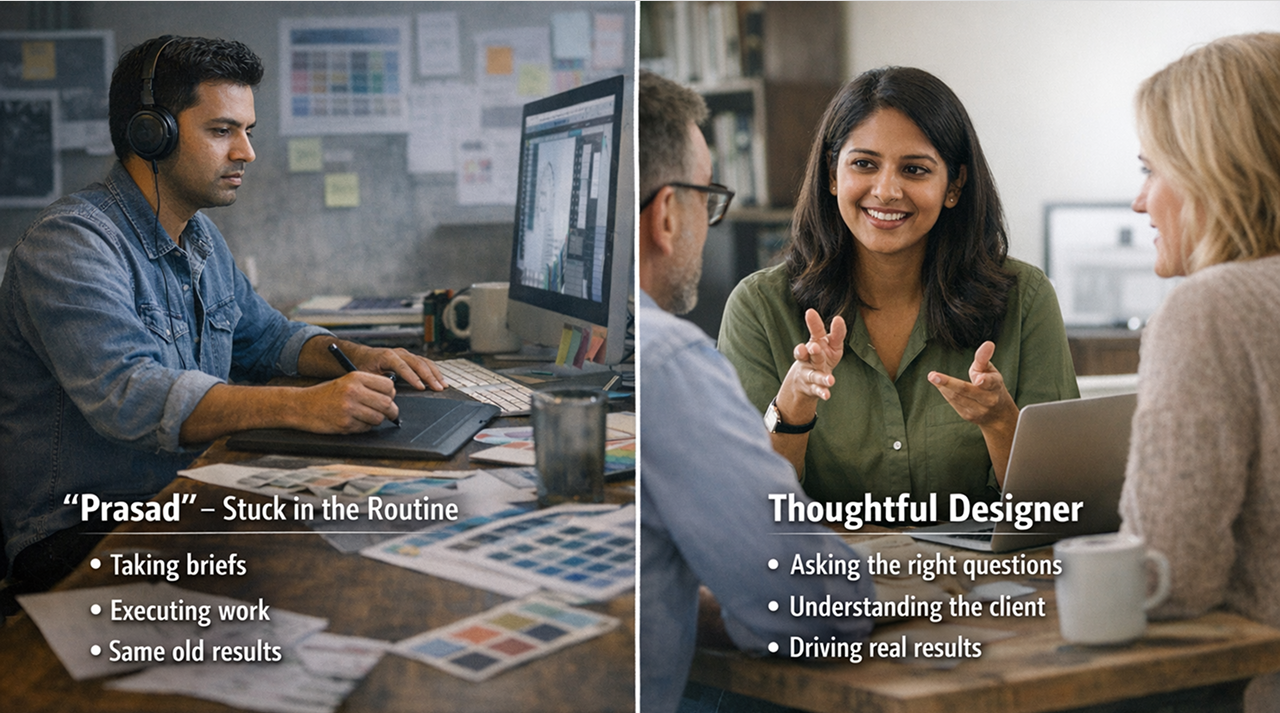
Consider two designers – both from the same city, same industry.
The first – let’s call him Prasad – six years of solid experience. Technically brilliant. Clients
loved his work. But every time a project came in, Prasad just executed it. Brief comes in. He
does it. Client approves. Done. Next brief. He never once asked: “Is this brief solving the right
problem?”
Across town – a designer with three fewer years of experience. But she worked differently.
Before touching a single file, she sat with the client and asked: “What do you actually need this
campaign to do in the next thirty days? Who is the exact person we’re trying to reach? What
does this person worry about at night? And what does failure look like for you?”
The client had never been asked those questions before.
What she found out changed everything. The client thought they had a visibility problem – they
wanted more people to see the brand. But after those questions, it became clear – the real
problem was trust. People knew the brand. They just didn’t believe it.
So instead of designing a loud, attention-grabbing campaign – she designed something quiet,
warm, and credible. Conversions went up thirty-five percent in six weeks.
The client didn’t just pay her more. They made her part of every future strategy conversation.
Prasad is still taking briefs. She’s now shaping them.
Same city. Same industry. Different thinking.
One Question That Can Change Your Entire Strategy
Here’s another example.
A digital marketing team in Delhi – good team, hardworking people – spent three months
making beautiful Instagram content for a wellness brand. Good design. Good captions.
Consistent posting. Engagement was flat. Almost zero growth.
Then a strategist joined and asked one question: “Who is the exact person we’re trying to reach
– and what is she thinking about, worrying about, searching for – before she even finds this
brand?”
They did the research. What they found was surprising. Their audience wasn’t looking for
wellness tips. They were young women in their early thirties who felt guilty – guilty about not
taking care of themselves, guilty about always putting everyone else first.
The content until then was aspirational – “here’s the healthy life you could have.” But what this
audience needed to hear was: “It’s okay. You’re not failing. Let’s start small.”
The team changed the entire tone. More empathy. Less perfection.
In eight weeks – engagement tripled, cost per lead dropped by half, and the brand started
getting DMs saying “this page feels like it gets me.”
Same team. Same budget. Same platform. One question changed everything.
That is strategic thinking.
How Management Identifies High-Growth Employees

Here’s something worth understanding – especially if you’re earlier in your career.
Management doesn’t promote the hardest worker in the room. They promote the person who
makes them feel – “this person thinks like us.”
When there’s a problem nobody has solved yet, who do they turn to? When there’s a big client
meeting, who do they bring in the room? When they’re planning something important – whose
opinion do they seek?
It’s never the person who just does good work.
It’s always the person who asks the right questions. Who sees the bigger picture. Who connects
what they’re doing to why it matters.
The moment they see that in you – even once – you get tagged differently. You stop being “a
resource.” You start becoming “someone we need in the room.” That tag is what opens every
door after that.
How to Start Thinking Strategically Today
The shift starts with one simple habit.
Before you start any piece of work – any brief, any project, any task – pause and ask three
questions:
● What problem is this actually solving?
● Who is it solving it for – really?
● How will we know if it worked?
Most people skip these entirely because nobody asks them to ask them. They just want the
work done.
But the moment you start asking – you change how people see you. You stop being the person
who does the task. You become the person who understands the task.
And that is a completely different career.
Want to Become a Cross-Functional Designer?
If you want to build skills across branding, UI/UX, web design, and motion graphics, the Designer Pro program at Web D School is designed to prepare you for the modern design industry.
✔ 11+ Years of Training Experience
✔ 6,000+ Graduates
✔ 93% Placement Rate
You’ll learn how to create complete design projects – not just isolated assignments.